
Nvidia B300 Server Crisis: AI Infrastructure Costs Double in China
Nvidia B300 AI servers reach $1 million in China amid US chip export restrictions, creating unprecedented infrastructure challenges for AI development.
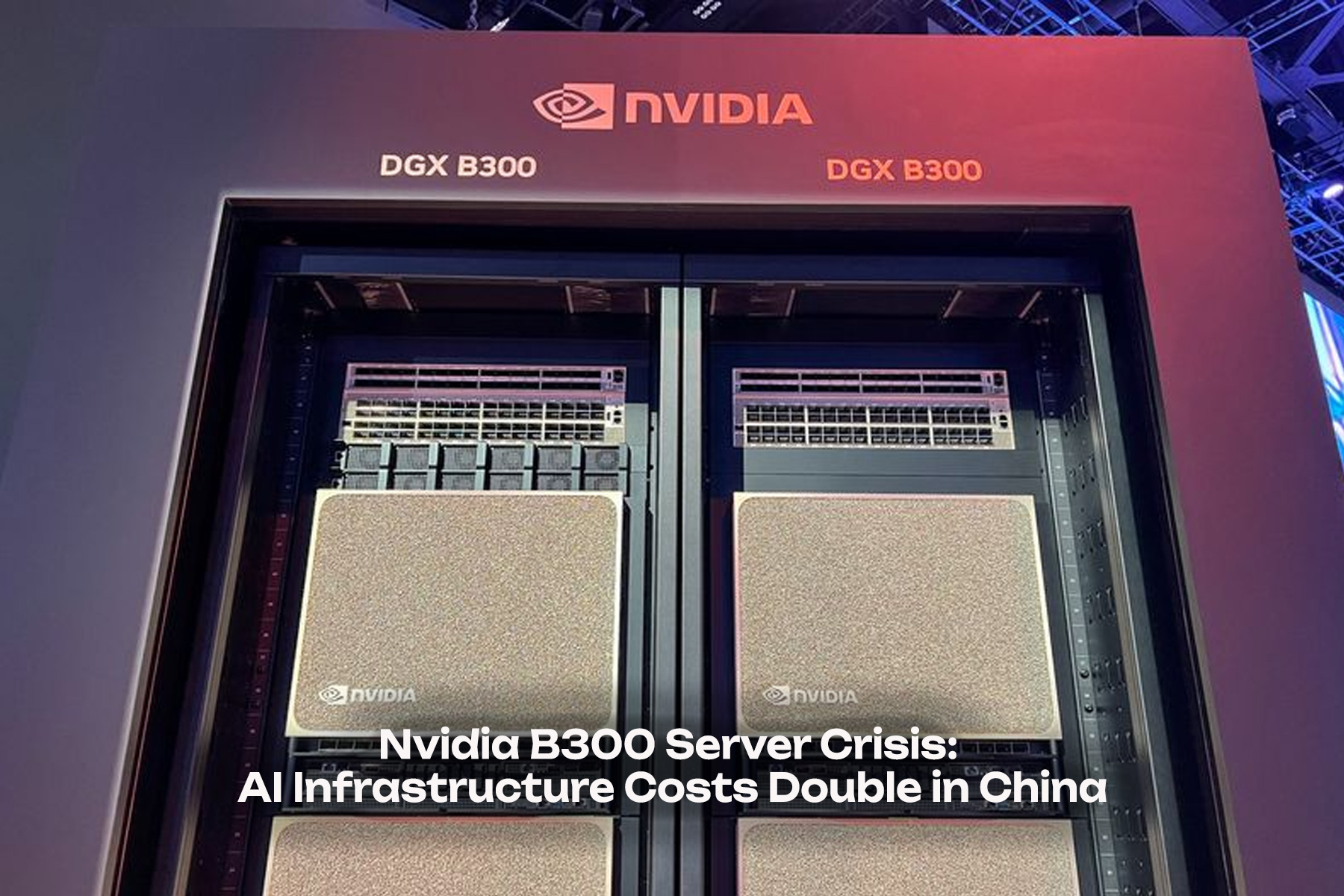
The AI infrastructure market faces a critical challenge as Nvidia B300 servers in China have reached approximately $1 million (7 million yuan) per unit, nearly doubling from previous levels. This price surge, driven by US chip export restrictions and subsequent crackdown on gray market chip supplies, creates significant barriers to AI development in China while highlighting the strategic importance of semiconductor technology in the global AI race.
Introduction
The AI industry relies fundamentally on computing infrastructure, and recent developments in China demonstrate how geopolitical factors can dramatically impact technology access. On May 7, 2026, reports emerged that Nvidia B300 servers have reached approximately $1 million each in the Chinese market - nearly double the price seen before implementation of expanded US export controls.
This price surge represents more than a market anomaly; it signals fundamental shifts in how AI development will proceed globally. Organizations must now factor infrastructure costs into strategic planning in ways that were previously unnecessary.
Understanding the Price Surge
The B300 Server Specification
The Nvidia B300 represents the latest generation of AI computing hardware designed for training and inference workloads:
| Specification | B300 | Previous Generation |
|---|---|---|
| Architecture | Blackwell | Hopper |
| Memory | HBM3e | HBM3 |
| Performance (TFLOPS) | 18,000+ | 8,000+ |
| Power Consumption | 1,200W | 700W |
| Price (US Market) | ~$35,000 | ~$20,00 |
The China Price differential
The $1 million price in China represents a premium of approximately 28x over US market pricing:
| Market | B300 Server Price | Premium |
|---|---|---|
| United States | $35,000-40,000 | Baseline |
| China (Current) | $1,000,000 | 28x |
| China (Pre-controls) | ~$500,000 | 14x |
This premium reflects multiple cost factors that have emerged from export restrictions.
Root Causes of the Price Surge
US Export Control Expansion
The United States has progressively expanded semiconductor export controls targeting China:
- October 2022 Controls: Initial restrictions on advanced chip technology
- October 2023 Expansion: Extended controls to cover more chip categories
- 2024-2025 Further Restrictions: Additional licensing requirements and entity list expansions
These controls specifically target AI development capabilities, recognizing the strategic importance of computing power in AI advancement.
Gray Market Disruption
Prior to current restrictions, organizations accessed advanced chips through various channels:
- Third-party intermediaries: Shell companies and distributors
- Modified specifications: Slightly downgraded chips avoiding restrictions
- Parallel imports: Shipments through third countries
The current administration has significantly enhanced enforcement, effectively eliminating these gray market pathways.
Supply-Demand Dynamics
The combination of restricted supply and growing demand creates inevitable price pressure:
- Chinese AI companies continue to grow and require infrastructure
- Domestic alternatives remain 2-3 generations behind
- Smuggling risks have increased substantially
Implications for AI Development
Cost Structure Impact
The price increase fundamentally alters the economics of AI development:
| Cost Category | Pre-Restriction | Current | Impact |
|---|---|---|---|
| Server Hardware | $500K | $1M | 2x |
| Data Center Space | $100K | $150K | 1.5x |
| Power Costs | $50K | $75K | 1.5x |
| Total Per Server | $650K | $1.25M | 1.9x |
Competitive Disadvantages
Chinese AI companies face significant competitive disadvantages:
- Higher Capital Requirements: Much higher entry barriers for new companies
- Slower Scaling: Difficulty achieving economies of scale
- Technology Gaps: Limited access to latest capabilities
Adaptation Strategies
Organizations are responding through various adaptations:
- Domestic Chip Development: Increased investment in Chinese alternatives
- Cloud-Based Solutions: Shifting to cloud infrastructure where available
- Efficiency Focus: Optimizing existing infrastructure usage
- Tiered Services: Differentiation based on available compute

Global Ramifications
Technology Sector Bifurcation
The semiconductor restrictions are contributing to technology sector bifurcation:
- Separate Ecosystems: Increasingly distinct Chinese and Western technology stacks
- Incompatible Standards: Diverging technical specifications
- Limited Interoperability: Reduced ability to integrate cross-border
Domestic Alternatives
Chinese companies are accelerating domestic chip development:
| Company | Chip | Status | Performance Gap |
|---|---|---|---|
| Huawei | Ascend 910B | Volume production | 2-3 generations |
| Cambricon | MLU370 | Limited production | 3+ generations |
| Biren | BR100 | Sampling | 2 generations |
| Metax | GX660M | Sampling | 3 generations |
Domestic alternatives remain years behind Nvidia in both performance and manufacturing capability.
Downstream Effects
The restrictions create ripple effects throughout the AI ecosystem:
- Reduced Competition: Limited competitive pressure on Western providers
- Higher Prices: Global pricing influenced by China constraints
- Innovation Incentives: Stronger incentives for domestic innovation
Future Outlook
Potential Scenarios
Several scenarios could play out:
Scenario 1: Continued Restrictions Export controls remain or intensify, maintaining high prices and infrastructure constraints in China.
Scenario 2: Diplomatic Resolution Negotiations lead to controlled openings, creating more predictable supply.
Scenario 3: Domestic Breakthrough Chinese companies achieve competitive alternatives, reducing dependence.
Industry Adaptation
Regardless of the policy path, the industry continues adapting:
- Diversified Supply Chains: Reducing single-source dependencies
- Efficiency Improvements: Making more with less compute
- Alternative Architectures: Exploring different computing paradigms
Conclusion
The Nvidia B300 server price surge to $1 million in China represents a concrete manifestation of the broader technology competition between the United States and China. These pricing dynamics demonstrate how geopolitical factors directly impact AI development capabilities and costs.
For organizations operating globally, this situation highlights the importance of:
- Infrastructure Planning: Factoring geopolitical risks into long-term planning
- Supply Chain Resilience: Building diversified supply chains
- Technology Assessment: Understanding the strategic dimensions of technology choices
The semiconductor restrictions fundamentally alter competitive dynamics in ways that go beyond simple market economics. As AI becomes increasingly strategic, these infrastructure considerations will only grow in importance.
The industry continues to evolve, with organizations and governments adapting to new realities. Whether through domestic alternatives, diplomatic resolution, or continued restriction, the fundamental challenge of AI infrastructure access will shape the competitive landscape for years to come.
Related Articles
The Great AI Inference Race: Google TPU vs Nvidia GPU in 2026
An analysis of the competition between Google's Tensor Processing Units and Nvidia's graphics processors for AI inference workloads, examining performance, economics, and market dynamics.

Energy: AI Data Centers Driving Massive Natural Gas Infrastructure Buildout
AI companies are constructing enormous natural gas power plants to meet the exploding energy demands of data centers, raising environmental and climate concerns.
NVIDIA Blackwell Dominance: 80% Market Share and the AI Chip Race
NVIDIA maintains iron grip on AI accelerator market with 80% share while Blackwell architecture powers the AI factory era