
The Great AI Inference Race: Google TPU vs Nvidia GPU in 2026
An analysis of the competition between Google's Tensor Processing Units and Nvidia's graphics processors for AI inference workloads, examining performance, economics, and market dynamics.
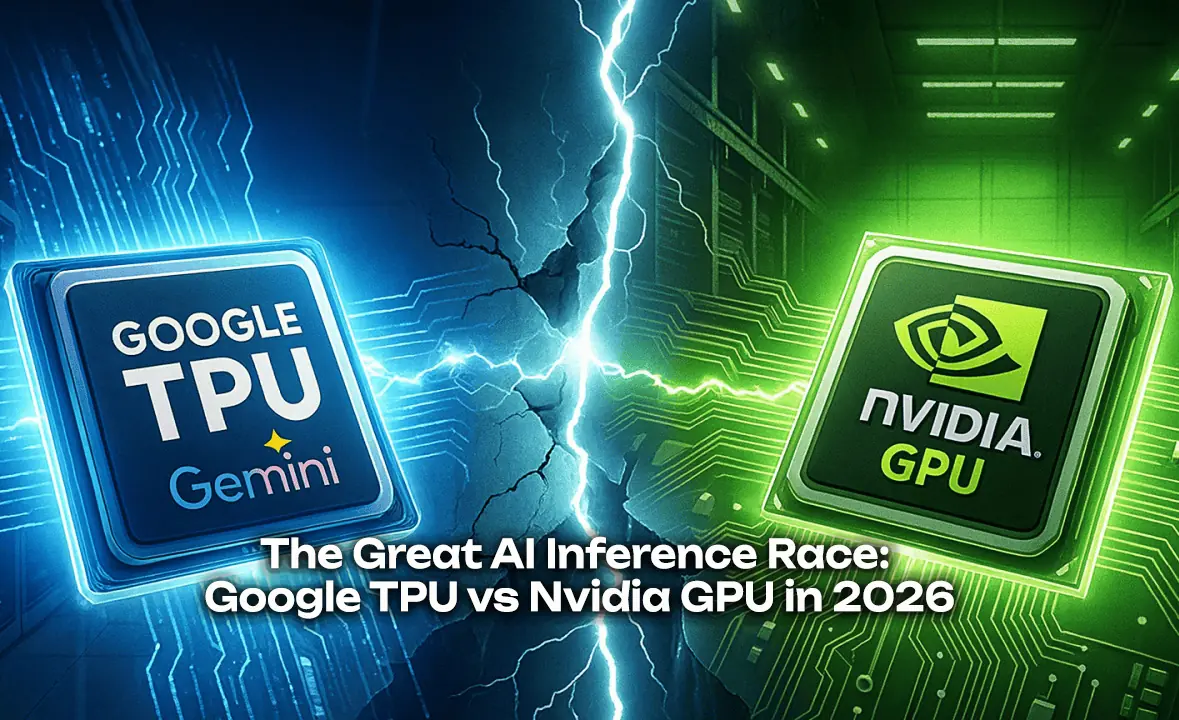
The AI hardware market has entered a new phase in 2026. While Nvidia has dominated AI computing for years, Google's Tensor Processing Units (TPUs) are achieving unprecedented performance levels in inference workloads—prompting enterprises to reconsider their infrastructure investments. This article examines the current state of the AI inference chip market, comparing Google's latest TPU offerings against Nvidia's mature GPU ecosystem.
Introduction
For most of the AI boom, the answer to "which chip should I use for AI?" was simple: Nvidia. The company's CUDA ecosystem and consistent architectural improvements made it the default choice for both training and inference.
That simplicity has eroded. Google's April 2026 announcements introduced new TPUs designed specifically for inference, while simultaneously revealing plans to sell these chips directly to external customers. This represents a fundamental shift in the AI hardware landscape.
Understanding these developments requires examining both the technical capabilities and the economic structures shaping the market.
The Inference vs Training Distinction
Before comparing chips, understanding the workload difference matters:
Training involves computing predictions, comparing them to actual outcomes, and adjusting model parameters—computationally intensive and memory-hungry. Historically, this favored Nvidia's strong GPU memory bandwidth.
Inference involves running trained models to generate outputs—increasingly critical as AI agents enter production. This workload is growing faster than training as deployed models far outnumber models in development.
Google's strategic focus on inference reflects this market shift. As companies deploy AI rather than merely develop it, inference-optimized hardware becomes economically attractive.
Google TPU: 2026 Architecture
The Ironwood Family
Google's April 2025 announcement introduced the Ironwood TPU, now shipping in production quantities. The 2026 refresh brings:
- TPU 8t for training workloads
- TPU 8i optimized specifically for inference
Notably, Google announced these would be sold to select external customers—a historic departure from internal-only TPU usage.
| Specification | TPU 8i (Inference) | TPU 8t (Training) |
|---|---|---|
| Peak Performance | Custom focus | Full precision |
| Cluster Size | 256 to 9,216 chips | Similar scaling |
| Target Workload | Inference | Training |
| Availability | Select customers | Limited |
| Pricing | Market rates | Market rates |
Performance Characteristics
Published benchmarks show the TPU 8i achieving:
- Lower latency than equivalent GPU configurations for standard inference workloads
- Superior efficiency in tokens-per-watt for sustained inference
- Strong scaling to 9,216-chip clusters for massive deployment
Google claims "more cost-effective than Nvidia's" for inference workloads, though independent verification remains limited.
Nvidia's Position
The Blackwell Architecture
Nvidia's Blackwell architecture, unveiled at GTC 2026, delivers significant inference improvements:
- Increased inference performance through dedicated transformer engine optimizations
- Enhanced memory bandwidth for long-context inference
- Improved token generation rates addressing the key inference bottleneck
The company dismisses custom silicon concerns. CEO Jensen Huang has repeatedly emphasized that general-purpose GPUs offer "greater flexibility for AI developers" than purpose-built alternatives.
The Ecosystem Advantage
Technical specifications tell only part of the story. Nvidia's advantages include:
- Mature CUDA ecosystem with decades of optimization
- Broad framework support from PyTorch, TensorFlow, and emerging AI frameworks
- Established tooling for deployment, monitoring, and optimization
- Supply chain reliability with demonstrated manufacturing scale
These factors create switching costs beyond raw chip performance.
Cost Analysis
Direct cost comparisons remain complex due to different business models:
Cloud Deployment
| Provider | Chip | Effective Performance/Dollar | Setup Complexity |
|---|---|---|---|
| Google Cloud | TPU 8i | Competitive | Moderate |
| Google Cloud | H100 | Established | Low |
| AWS | Nvidia H100 | Established | Very Low |
| AWS | Nvidia H200 | High | Low |
| Azure | Nvidia H100 | Established | Very Low |
On-Premise Deployment
Google's decision to sell TPUs externally changes the calculus. Organizations now face:
- Capital expenditure for on-premise hardware
- Ongoing operational costs for cloud instances
- Opportunity costs of staff expertise development
For most enterprises, the Nvidia ecosystem's established tooling offsets any TPU performance advantages.
Market Dynamics
Google's Strategic Shift
The decision to sell TPUs externally reflects changed market conditions:
- Demand visibility: Companies know AI is real—hardware investment makes sense
- Competitive pressure: AMD, Amazon, and others challenge Nvidia
- Revenue optimization: Monetizing years of TPU development investment
Google joins Amazon (Trainium) in offering custom silicon alternatives—a significant market shift from exclusive internal use.
Enterprise Adoption Patterns
Early adoption shows:
- New AI companies more willing to evaluate TPUs
- Established enterprises largely sticking with Nvidia
- Cost-sensitive workloads driving TPU consideration
- Performance-critical applications remaining GPU-dependent
Technical Trade-offs
| Factor | TPU Advantage | GPU Advantage |
|---|---|---|
| Inference speed | Leading on standard benchmarks | Mature optimization |
| Framework support | Limited (JAX/TensorFlow) | Broad (all major frameworks) |
| Flexibility | Purpose-built for specific tasks | General-purpose capability |
| Ecosystem | Developing | Established |
| Scaling | Excellent at scale | Proven at scale |
| Availability | Limited | Widely available |
The Custom Silicon Trend
Beyond Google and Nvidia, multiple players develop AI-focused chips:
- Amazon (AWS): Trainium and Inferentia chips seeing increased adoption
- AMD: MI300 series targeting the AI accelerator market
- Microsoft: Maia AI chip development progressing
- OpenAI: Exploring custom silicon partnerships
This diversity suggests the market believes general-purpose GPUs face meaningful custom silicon competition.
Making Infrastructure Decisions
Organizations evaluating AI hardware should consider:
When to Consider TPUs:
- Inference-heavy workloads dominate your usage
- Cost optimization is critical
- You're building on Google Cloud infrastructure
- You can absorb framework limitations
When to Stick with GPUs:
- Framework flexibility matters
- Your team has existing CUDA expertise
- Training workloads remain significant
- Vendor diversity is strategically important
Future Outlook
The AI inference market will likely remain heterogeneous. No single architecture will dominate:
- Nvidia retains ecosystem and flexibility advantages
- Google TPUs capture cost-sensitive inference workloads
- Others (AMD, Amazon) provide competitive pressure
The key insight: hardware choice increasingly depends on specific workload characteristics rather than general recommendations.
Conclusion
The 2026 AI inference hardware market offers genuine alternatives to the Nvidia monopoly that characterized previous years. Google's TPU 8i represents a credible competitor for inference workloads, achieving competitive performance at potentially lower cost.
However, the ecosystem advantage remains significant. Organizations with established Nvidia infrastructure, CUDA expertise, and diverse framework needs will find the switching costs unjustified. New organizations, particularly those building inference-first applications, should evaluate TPUs as part of their infrastructure decisions.
The ultimate winner may be enterprise buyers—not through choosing a single vendor, but through the competitive pressure that drives continued innovation across all players.
Related Articles
Energy: AI Data Centers Driving Massive Natural Gas Infrastructure Buildout
AI companies are constructing enormous natural gas power plants to meet the exploding energy demands of data centers, raising environmental and climate concerns.
NVIDIA Blackwell Dominance: 80% Market Share and the AI Chip Race
NVIDIA maintains iron grip on AI accelerator market with 80% share while Blackwell architecture powers the AI factory era

How Model Context Protocol Is Becoming the Standard for AI Tool Integration
MCP adoption is accelerating across enterprise and developer platforms, with 97M+ installs, enterprise ad platforms, and IDE integrations making it the de facto AI tool standard.