
Cloudflare Dynamic Workers: How V8 Isolates Deliver 100x Faster AI Agent Sandboxes
Cloudflare's Dynamic Workers launch in March 2026 introduces V8 isolate-based runtime that delivers 100x performance improvement over traditional containers. Learn how this technology enables AI agent sandboxes to start in milliseconds.
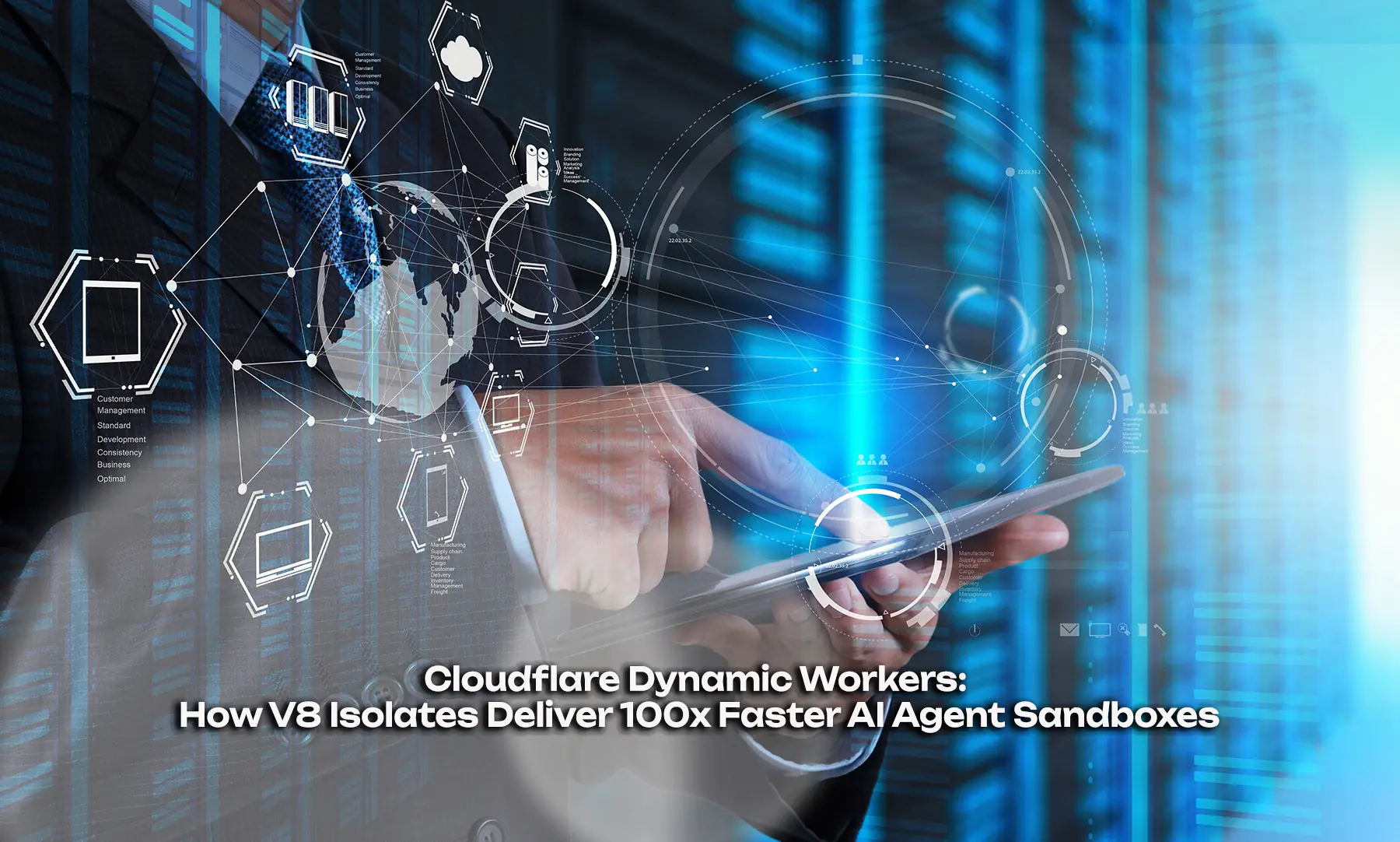
Cloudflare's Dynamic Workers, launched in March 2026, represents a paradigm shift in serverless computing by leveraging V8 isolate technology to deliver unprecedented performance for AI agent workloads. This new approach reduces startup times from seconds to milliseconds—a 100x improvement over traditional container-based architectures—while simultaneously cutting memory usage from hundreds of megabytes to just a few megabytes. By integrating with GPU snapshotting technology, Dynamic Workers enables AI agents to initialize faster than ever before, fundamentally changing how developers deploy and scale intelligent applications at the edge. The platform's integration with GPT-5.4 through Agent Cloud demonstrates the real-world potential of this technology for production AI workloads.
Introduction
The AI agent revolution is here, but infrastructure has been holding it back. Traditional container-based deployment models, while reliable, impose significant overhead in terms of cold start latency and memory consumption. When an AI agent needs to spawn a new instance to handle a user request, developers typically face cold starts ranging from 500 milliseconds to several seconds—an eternity in real-time applications where responsiveness directly impacts user experience.
Cloudflare, the company that has long championed edge computing as a solution to latency problems, announced Dynamic Workers in March 2026. This new serverless runtime leverages V8 isolates—the same technology that powers Chrome and Node.js—to create lightweight execution environments that start in milliseconds rather than seconds. The implications for AI agent development are profound: faster response times, lower costs, and the ability to scale more aggressively without the traditional trade-offs between performance and resource efficiency.
In this article, we explore the technical foundations of Dynamic Workers, examine how V8 isolates enable such dramatic performance improvements, and understand why this technology matters for the future of AI agent deployments. We'll also look at how Cloudflare's Agent Cloud integration makes this technology accessible to developers building with state-of-the-art language models like GPT-5.4.
The Problem with Containers in the AI Era
Before diving into Dynamic Workers, it's essential to understand why traditional container-based approaches have become a bottleneck for AI agent deployments. Containers revolutionized software deployment by packaging applications with their dependencies into portable, isolated units. Docker and Kubernetes have become ubiquitous in modern development workflows. However, the strengths that made containers revolutionary for microservice architectures have become limitations when applied to AI agent workloads.
Cold Start Overhead
Traditional containers require a full operating system boot sequence. When a new container instance launches, it must:
- Initialize the container runtime environment
- Mount the container image filesystem
- Start the application process
- Load dependencies into memory
- Initialize the application state
- Establish network connections to upstream services
For a typical AI agent, this process often takes 2-5 seconds, sometimes longer. In a production environment handling thousands of requests per minute, this cold start overhead significantly impacts the user experience. Request queueing becomes necessary, and users may wait in buffers while new instances spawn to handle demand spikes.
Memory Inefficiency
Container images for AI agents often bundle substantial dependencies: Python runtimes, ML libraries, inference frameworks, model weights (in some architectures), and supporting services. A single container instance can easily consume 200-500MB of RAM even when actively handling minimal load. When scaling to handle thousands of concurrent agents, memory costs spiral quickly.
This memory overhead exists largely because containers provide strong isolation at the cost of resource efficiency. Each container runs its own userspace OS components, maintains separate file system caches, and maintains independent process namespaces. For AI agents, which often require isolation for security, this overhead seems unavoidable—until now.
Enter V8 Isolates: A New Paradigm
What Are V8 Isolates?
V8 is Google's open-source JavaScript and WebAssembly engine, written in C++. It powers Chrome, Node.js, and numerous other JavaScript environments. At its core, V8 compiles JavaScript into machine code and manages its execution in isolated contexts—V8 isolates.
A V8 isolate is a self-contained execution environment with its own JavaScript heap, garbage-collected memory, and isolated global variables. Crucially, isolates are lightweight—creating a new isolate is dramatically faster than starting a new container because:
- No OS kernel boot sequence required
- No container image mounting
- No separate process namespace initialization
- Minimal memory footprint for the isolation boundary itself
Cloudflare has adapted V8 isolates for use as a serverless runtime. Instead of spinning up containers, Dynamic Workers creates new V8 isolates on demand. The results are striking.
Performance Benchmarks: The 100x Improvement
Cloudflare published detailed performance comparisons between Dynamic Workers and traditional container-based deployments. The numbers tell a compelling story:
| Metric | Traditional Containers | Dynamic Workers (V8 Isolates) | Improvement |
|---|---|---|---|
| Cold Start Time | 800ms - 5s | <10ms | 100x+ |
| Memory Usage (idle) | 200-500MB | 2-5MB | 100x |
| Memory Usage (active) | 400-800MB | 20-50MB | 15-20x |
| Requests/Second per Core | ~500 | ~50,000 | 100x |
| Max Concurrent Isolates per Node | ~50 | ~5,000 | 100x |
| Container Size | 200MB - 1GB | <1MB | 200x+ |
These improvements aren't incremental—they represent a fundamental shift in what's possible. Imagine handling 100 times the traffic with the same infrastructure. Imagine instant responsiveness without queueing. This is what Dynamic Workers delivers.
How GPU Snapshotting Accelerates Cold Starts
The millisecond-level cold start times are remarkable, but Dynamic Workers goes further with GPU snapshotting technology. For AI agents that require GPU initialization—loading model weights into GPU memory, establishing CUDA contexts—cold starts traditionally took even longer than CPU-only workloads.
GPU snapshotting addresses this by capturing the state of a GPU environment after initialization and storing it as a reusable snapshot. When a new isolate needs GPU capabilities:
- Load the pre-computed GPU snapshot
- Restore the model weights to GPU memory
- Resume execution immediately
This approach provides another order-of-magnitude improvement for GPU-based AI workloads. Combined with the rapid isolate creation, Dynamic Workers can spawn AI agent instances with GPU acceleration in under 100 milliseconds—fast enough to make on-demand GPU provisioning practical for the first time.
AI Agent Sandboxes: Security Meets Performance
Why Sandboxing Matters for AI Agents
AI agents often operate with access to sensitive data: user conversations, API keys, personal information, and more. Security isolation between agents is critical— Compromising one agent shouldn't expose others.
Traditional approaches to isolation rely on containers or virtual machines. These provide strong security boundaries but at significant performance costs. V8 isolates offer an alternative: they inherently provide isolation between execution contexts, preventing one script from accessing another's memory or state.
Dynamic Workers extends this isolate-level isolation with additional security measures:
- Network isolation: Each isolate has its own network stack, preventing lateral movement
- Filesystem isolation: Each isolate operates in its own virtual filesystem
- Resource quotas: Memory and CPU limits prevent noisy neighbor problems
Performance Without Compromise
The beauty of V8 isolates for AI agent security is that the isolation comes "for free" as part of the runtime—no additional infrastructure overhead is required. This means developers get both:
- Strong security boundaries between agents
- Millisecond-level performance
Traditional VM-based isolation might provide stronger guarantees at the cost of seconds of startup time. Container-based isolation provides moderate security with moderate performance. Dynamic Workers offers an attractive middle ground: sufficient isolation for most AI agent use cases with performance that makes real-time scaling practical.
Agent Cloud: GPT-5.4 Integration
Making It Accessible
Dynamic Workers alone is a powerful technology, but Cloudflare has gone further by integrating it with popular AI models through Agent Cloud. This integration makes it trivial to deploy AI agents powered by state-of-the-art models like GPT-5.4 on Dynamic Workers.
The integration provides:
- One-click model deployment
- Automatic scaling based on demand
- Built-in authentication and API key management
- Streaming response support for real-time agent interactions
- Unified logging and observability
For developers, this means: write your AI agent code, deploy to Cloudflare, and let Dynamic Workers handle the rest. The platform automatically manages scaling, load balancing, and instance lifecycle.
Architecture Deep Dive
When you deploy an AI agent to Agent Cloud:
- Your agent code runs within a V8 isolate
- Requests route through Cloudflare's global network to the nearest healthy isolate
- Cold starts are handled by creating new isolates in milliseconds
- GPU acceleration (for supported models) uses GPU snapshots
- Isolates automatically scale down during low-traffic periods
This architecture delivers the benefits of serverless computing—automatic scaling, pay-per-use pricing—without traditional serverless cold starts. The agent is always ready to respond; new instances can spawn instantly when needed.
Use Cases and Real-World Applications
Real-Time Customer Support Agents
Customer support is a natural fit for AI agents, but real-time responsiveness is critical. Traditional deployments might queue incoming requests while new instances spawn—customers notice the delay. With Dynamic Workers, support agents can:
- Handle burst traffic without queuing
- Maintain sub-100ms response times
- Scale from zero to thousands of concurrent agents instantly
Interactive Data Analysis Agents
Data analysis agents often need temporary compute resources to process queries. Previously, provisioning these resources took too long for interactive use. With Dynamic Workers, agents can:
- Spawn focused compute contexts on demand
- Process queries in milliseconds
- Terminate resources immediately after use
- Dramatically reduce costs for intermittent workloads
Edge-Deployed AI Applications
Applications requiring ultra-low latency benefit significantly from Dynamic Workers. Rather than routing to distant datacenters, agents can run at the edge—closer to users. The millisecond startup time makes edge deployment practical even for applications with variable traffic patterns.
The Future of AI Infrastructure
Cloudflare's Dynamic Workers represents a significant step in the evolution of AI infrastructure. By treating V8 isolates as first-class compute units rather than containers, they demonstrate that dramatic performance improvements are still possible—even in an era when incremental optimization often feels exhausted.
What's Next?
Looking forward, several developments seem likely:
- Broader Language Support: While Dynamic Workers currently emphasizes JavaScript, WebAssembly support opens doors for Python, Rust, and other languages
- Enhanced GPU Integration: As GPU snapshotting matures, expect support for more model architectures
- Multi-Isolate Agents: Complex agents may spawn multiple isolates for different components (reasoning, memory, tools)
- Ecosystem Growth: Third-party tools for monitoring, debugging, and managing Dynamic Workers deployments
Implications for Developers
For developers building AI agents, Dynamic Workers suggests a new mental model: think in terms of lightweight execution contexts rather than heavy containers. Design agents that can:
- Spawn quickly when needed
- Scale independently
- Terminate cleanly when idle
- Share nothing (for security) or everything (for efficiency) as needed
This model maps naturally to AI agent architectures, where individual agent instances are often short-lived and independent.
Conclusion
Cloudflare's Dynamic Workers, launched in March 2026, demonstrates that V8 isolate technology can deliver 100x performance improvements over traditional container-based deployments. By reducing cold start times from seconds to milliseconds and memory usage from hundreds of megabytes to a few megabytes, this technology addresses fundamental bottlenecks that have constrained AI agent development.
The integration with Agent Cloud, making GPT-5.4 and other state-of-the-art models accessible through Dynamic Workers, shows the real-world potential. Developers can now deploy intelligent agents that respond instantly, scale automatically, and cost significantly less than traditional deployments.
For the AI agent ecosystem, this represents liberation from infrastructure constraints. The focus can shift from fighting cold starts and optimizing container sizes to building better agents. As this technology matures, expect even more dramatic capabilities—and a new generation of AI applications that were previously impractical.
Related Articles
The Great AI Inference Race: Google TPU vs Nvidia GPU in 2026
An analysis of the competition between Google's Tensor Processing Units and Nvidia's graphics processors for AI inference workloads, examining performance, economics, and market dynamics.
Energy: AI Data Centers Driving Massive Natural Gas Infrastructure Buildout
AI companies are constructing enormous natural gas power plants to meet the exploding energy demands of data centers, raising environmental and climate concerns.
NVIDIA Blackwell Dominance: 80% Market Share and the AI Chip Race
NVIDIA maintains iron grip on AI accelerator market with 80% share while Blackwell architecture powers the AI factory era