
AI Observability: Monitoring Production Language Models at Scale
A comprehensive guide to monitoring AI models in production, covering performance metrics, drift detection, alerting, and debugging strategies for enterprise deployments.

As AI systems transition from experimental prototypes to mission-critical production infrastructure, the need for robust observability has become paramount. Unlike traditional software systems, AI models present unique monitoring challenges: they can degrade silently, exhibit behavior drift without code changes, and produce outputs that are difficult to quantify. This article examines the current state of AI observability, providing practical frameworks for monitoring production language models, detecting data and concept drift, and establishing alerting systems that catch problems before they impact users. We explore industry-standard tools, key performance indicators, and real-world debugging strategies employed by leading AI teams.
Introduction
The journey from training a machine learning model to deploying it reliably in production is fraught with challenges that most tutorials gloss over. Organizations investing heavily in AI infrastructure quickly discover that model deployment is only the beginning. The real work begins when models start serving real users — and that's precisely where observability becomes essential.
AI observability encompasses the ability to understand the internal states and outputs of AI systems through their external signals. It goes beyond traditional application monitoring by incorporating model-specific metrics, input/output analysis, and behavioral patterns that traditional APM tools simply cannot capture. A request that returns a 200 status code is not necessarily successful if the AI model produces a confidently wrong answer.
This distinction between operational health and model health is fundamental. A model can be technically operational — responding quickly and without errors — while being fundamentally broken from an accuracy or relevance standpoint. The notorious cases of AI systems silently degrading over weeks or months, delivering increasingly irrelevant or biased outputs without any infrastructure alerts, have made this abundantly clear to organizations across every industry.
The Unique Challenges of AI Monitoring
Monitoring AI systems differs from monitoring traditional software in several critical dimensions. Understanding these challenges is the first step toward building effective observability systems.
Quantifying Quality Without Ground Truth
Traditional software monitoring relies on well-defined success criteria. A database returns a result or an error. An API responds within a certain latency or times out. These binary outcomes translate naturally into monitoring metrics. AI systems, particularly language models, operate on a fundamentally different plane. How do you define "correct" when the model is generating creative content, summarizing documents, or answering open-ended questions?
This problem becomes even more complex when considering that many production AI applications lack immediate ground truth. A model might generate what appears to be a reasonable response, and only hours or days later might a human reviewer identify a subtle but significant error. This delayed feedback loop makes real-time quality assessment extraordinarily difficult.
The Behavioral Drift Problem
Software systems typically break suddenly — a deployment introduces a bug, a dependency goes down, or a configuration change has unintended consequences. The failure is immediate and detectable through traditional monitoring. AI systems, however, can degrade gradually as the data distribution in production shifts away from the distribution the model was trained on.
This phenomenon, known as concept drift or data drift, can cause models to slowly become less accurate, more biased, or less relevant without any code or configuration changes. A customer service chatbot trained on historical conversations might become increasingly ineffective as new products launch, new terminology emerges, or customer communication patterns evolve. The model isn't broken in any technical sense — it just no longer reflects the world it was designed to navigate.
The Black Box Nature
Deep learning models, particularly large language models, are notoriously difficult to interpret. Understanding why a model produced a specific output often requires techniques from the emerging field of AI interpretability. This makes debugging challenging, as operators cannot simply trace through code to understand a model's decision-making process. When a model produces an unexpected output, the debugging process often resembles scientific investigation rather than traditional software debugging.
Key Metrics for AI Observability
Effective AI observability requires monitoring metrics across multiple dimensions. Let's examine the key categories that comprehensive monitoring systems should track.
Infrastructure Metrics
The foundation of AI observability begins with infrastructure-level metrics that apply regardless of the specific AI application:
| Metric | Description | Alert Threshold | Measurement Method |
|---|---|---|---|
| Response Latency | Time to first token | > 95th percentile | Infrastructure logging |
| Throughput | Requests per second | Below capacity | Load balancer metrics |
| Error Rate | Failed requests | > 1% | API gateway logs |
| Token Usage | Tokens consumed per request | Budget alerts | API metering |
| GPU/CPU Utilization | Hardware usage | > 90% sustained | System monitoring |
| Memory Usage | RAM consumption | Approaching limits | Container metrics |
These infrastructure metrics provide the first line of defense against system failures. They are relatively straightforward to monitor using existing APM tools and provide clear, actionable alerts when thresholds are exceeded.
Model-Specific Metrics
Beyond infrastructure health, AI observability requires model-specific metrics that capture the behavior and quality of the model itself:
Per-Request Quality Signals: While true quality assessment requires human feedback, several proxy metrics can provide immediate insight into model behavior. Log the confidence scores for key outputs, track the length and structure of generated responses, and monitor the distribution of topics and domains the model encounters in production.
Input Distribution Monitoring: Track the types and distributions of inputs the model receives. Sudden shifts in input patterns — a new category of questions, unusual query lengths, or unexpected languages — can indicate drift or potential abuse. This monitoring is particularly important for models deployed in customer-facing applications.
Output Distribution Tracking: Similarly, monitor the statistical properties of model outputs. Are responses becoming longer or shorter over time? Is the model exploring a narrower or wider range of vocabulary? Are certain types of responses becoming more or less frequent? These distributional shifts often precede quality degradation.
Business Outcome Metrics
The most important metrics ultimately tie AI performance to business outcomes. While these metrics are the slowest to change and the most indirect, they provide the ultimate validation of whether an AI system is delivering value:
| Metric | Description | Data Source | Review Frequency |
|---|---|---|---|
| Task Completion Rate | % of user goals achieved | User analytics | Weekly |
| Escalation Rate | % of interactions requiring human handoff | Support system | Daily |
| User Satisfaction | CSAT/NPS scores for AI interactions | Feedback surveys | Weekly |
| Error Impact | Rate of errors causing business impact | Business systems | Daily |
| Cost per Interaction | Infrastructure cost per successful request | Cost analytics | Monthly |
Drift Detection: Identifying Silent Degradation
Drift detection represents one of the most critical and challenging aspects of AI observability. It involves identifying when the statistical properties of a model's inputs, outputs, or predictions change in ways that may affect performance.
Types of Drift
Understanding the different types of drift helps in selecting appropriate detection methods:
Data Drift occurs when the distribution of input data changes over time. A spam detection model trained on historical emails might experience data drift as email patterns evolve with new communication styles, platforms, and social engineering techniques. Data drift is typically the easiest to detect and often serves as an early warning sign.
Feature Drift is a specific form of data drift where the statistical properties of individual input features change. This can occur even when the overall input distribution appears stable. Feature drift often indicates changes in the underlying data generation process and may require retraining or feature engineering adjustments.
Concept Drift is the most insidious form of drift. It occurs when the relationship between input features and the target variable changes. A loan approval model might experience concept drift if economic conditions change the meaning of creditworthiness signals that were stable during training. Concept drift is difficult to detect because it doesn't necessarily manifest in input or output distribution changes.
Prediction Drift occurs when the distribution of model outputs changes over time, even if input distributions remain stable. This can indicate that the model is encountering novel situations that require updated training or that the model's internal representations are shifting.
Statistical Methods for Drift Detection
Modern drift detection employs various statistical techniques, from simple methods to sophisticated machine learning approaches:
Population Stability Index (PSI): One of the most widely used metrics for monitoring score distribution stability. PSI compares the distribution of a variable between two time periods, flagging significant shifts that warrant investigation.
Statistical Tests: Chi-squared tests, Kolmogorov-Smirnov tests, and other statistical methods can detect changes in distributions over time. These tests provide rigorous statistical validation of drift but may be too sensitive for production environments with noisy data.
Distance-Based Methods: Techniques like Wasserstein distance, KL divergence, and cosine distance measure the similarity between distributions, flagging when distributions diverge beyond acceptable thresholds.
Learned Drift Detectors: Some teams employ machine learning models specifically trained to detect drift, using techniques like clustering-based methods or autoencoders trained on normal data distributions.
Implementing a Drift Detection Pipeline
Building an effective drift detection system requires careful architecture. Here's a practical framework:
Establish Baselines: Collect input, output, and prediction distributions during the initial stable period of model deployment. These baselines represent your reference distributions.
Continuous Sampling: Systematically sample production traffic to enable ongoing distribution comparison. The sample rate should be high enough to detect meaningful changes quickly but not so high as to overwhelm storage and analysis systems.
Automated Alerting: Configure alerts that trigger when drift metrics exceed thresholds. Thresholds should be calibrated based on historical noise levels to minimize false positives while catching meaningful drift.
Investigation Workflows: When drift is detected, establish clear processes for investigation. This includes examining which specific features or output characteristics have shifted and assessing whether the drift is likely to impact model performance.
Retraining Triggers: Define clear criteria for when detected drift warrants model retraining. This decision should balance the cost of retraining against the business impact of continued model degradation.
Logging and Debugging Strategies
Effective logging forms the foundation of AI observability. Without comprehensive logs, debugging production issues becomes a game of guesswork.
Structured Logging for AI Systems
AI systems generate diverse outputs that require rich, structured logging. Each inference request should log:
- Unique request identifier for traceability
- Full input prompt (for debugging)
- Model version and configuration
- Timestamps at each processing stage
- Token counts and usage metrics
- Output (or error details)
- Request metadata (user context, session information)
This structured approach enables post-hoc analysis, debugging, and the construction of datasets for evaluation and improvement. It also supports compliance requirements in regulated industries where AI decisions must be explainable.
Debugging Production Issues
When production issues arise, a systematic debugging approach proves essential:
Reproduce with Logs: Use request identifiers to reconstruct the exact input that caused the issue. Reproducing the problem locally is the first step toward understanding it.
Version Correlation: Check whether any infrastructure, model, or configuration changes correlate with the onset of issues. Even seemingly unrelated changes can have cascading effects.
Distribution Analysis: Compare the input distribution during the problem period against baseline distributions. Often, production issues stem from encountering novel input patterns.
Output Analysis: Examine the characteristics of problematic outputs. Are they longer or shorter than normal? Do they share stylistic or structural patterns? Understanding the nature of failures often reveals their cause.
Human Feedback Integration: Incorporate human feedback where available. User corrections, feedback, and escalations provide invaluable signals that automated metrics cannot capture.
Industry Tools for AI Observability
The AI observability tooling landscape has matured significantly, with both specialized platforms and general-purpose solutions addressing the unique needs of production AI systems:
| Tool | Focus | Key Strength | Best For |
|---|---|---|---|
| Arize AI | ML observability | Automatic drift detection | Enterprise deployments |
| Whylabs | Data/ML monitoring | Open-source option | Cost-conscious teams |
| Fiddler | Model monitoring | Explainability features | Regulated industries |
| Gantry | ML evaluation | Feedback integration | Product teams |
| Humanloop | LLM evaluation | Prompt experimentation | Development teams |
| Phoenix (Arize) | Open-source | Local inference monitoring | ML teams |
These tools range from comprehensive enterprise platforms to lightweight open-source options, enabling organizations of all sizes to implement effective observability practices.
Conclusion
AI observability represents a fundamental shift in how we approach production system monitoring. It extends traditional application performance monitoring with model-specific insights, behavioral analysis, and business outcome tracking. As AI systems become increasingly mission-critical, the ability to understand, monitor, and debug these systems will become a core competency for technology organizations.
Building effective AI observability requires investment in infrastructure, tooling, and processes. The initial effort is substantial, but the payoff is significant: systems that can be trusted to operate reliably, issues that are caught before they become crises, and continuous improvement based on real-world performance data. In an era where AI systems increasingly make consequential decisions, observability is not optional — it is essential infrastructure.
Organizations that prioritize AI observability position themselves to deploy AI systems with confidence, iterate based on real performance data, and build the institutional knowledge necessary to succeed in an AI-powered future.
Related Articles
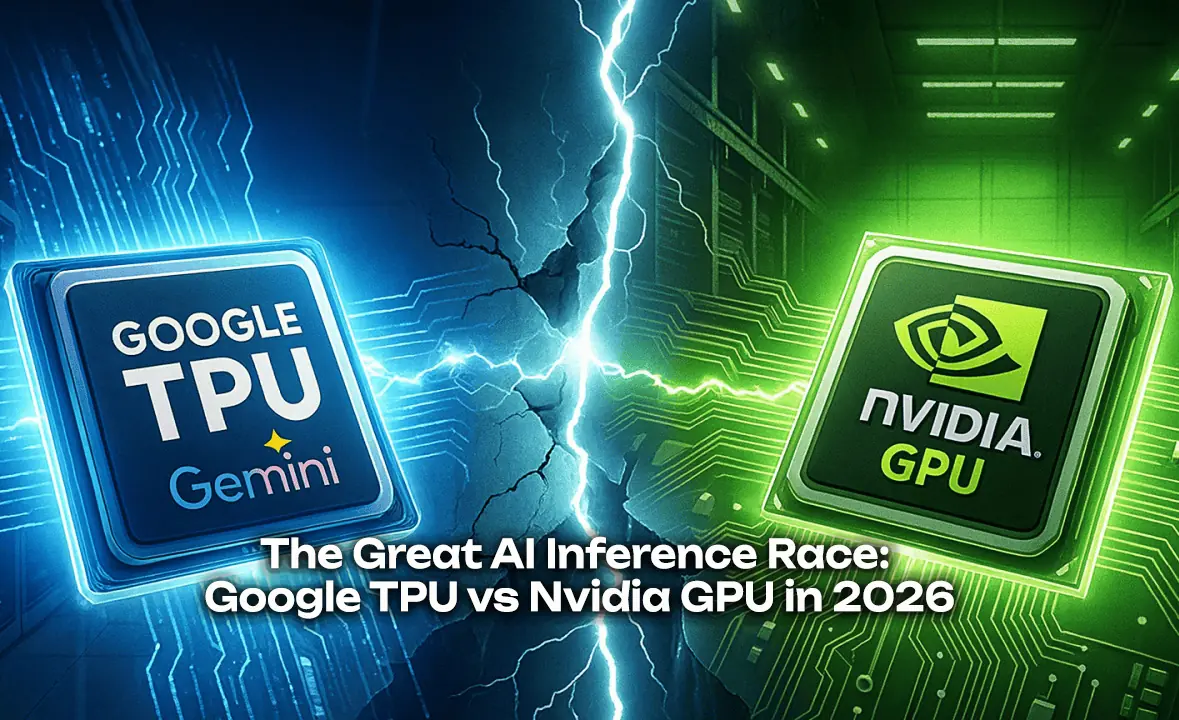
The Great AI Inference Race: Google TPU vs Nvidia GPU in 2026
An analysis of the competition between Google's Tensor Processing Units and Nvidia's graphics processors for AI inference workloads, examining performance, economics, and market dynamics.

Energy: AI Data Centers Driving Massive Natural Gas Infrastructure Buildout
AI companies are constructing enormous natural gas power plants to meet the exploding energy demands of data centers, raising environmental and climate concerns.
NVIDIA Blackwell Dominance: 80% Market Share and the AI Chip Race
NVIDIA maintains iron grip on AI accelerator market with 80% share while Blackwell architecture powers the AI factory era