
Global AI Adoption Reaches 17.8%: Microsoft's 2026 Report Analysis
Microsoft's latest report reveals global AI adoption increased to 17.8% of working-age population in Q1 2026, marking a 1.5 percentage point rise from 16.3%.
Microsoft's newly released report on global AI diffusion in 2026 reveals significant progress in artificial intelligence adoption worldwide. The data shows adoption increased from 16.3% to 17.8% of the global working-age population during Q1 2026, representing a 1.5 percentage point increase. This analysis examines the implications of this growth, regional variations, and what it means for the future of AI integration across industries.
Introduction
The first quarter of 2026 marks a pivotal moment in the global adoption of artificial intelligence. According to Microsoft's latest report released on May 7, 2026, AI usage has increased by 1.5 percentage points, rising from 16.3% to 17.8% of the world's working-age population. This growth, while seemingly modest in percentage terms, represents millions of new users entering the AI ecosystem and signals a fundamental shift in how organizations and individuals approach AI integration.
The diffusion of AI technology across global markets reflects a maturing ecosystem where barriers to entry continue to decrease while capabilities expand. Microsoft's report provides crucial insights into the current state of AI adoption and offers a roadmap for understanding where the technology is heading in the coming years.
Understanding the Q1 2026 Adoption Data
Methodology and Measurement
Microsoft's AI diffusion report employs a comprehensive methodology for tracking AI adoption across global markets. The measurement considers multiple factors including:
- Active usage of AI-powered applications and tools
- Integration of AI into business processes
- Consumer-facing AI implementations
- Enterprise AI deployment
The 1.5 percentage point increase from 16.3% to 17.8% translates to approximately 120 million additional individuals actively using AI in their work or daily activities. This growth occurs against a backdrop of increasing accessibility and decreasing cost barriers that have made AI tools more attainable than ever before.
Regional Adoption Patterns
The global nature of AI adoption reveals interesting regional dynamics. While developed markets continue to lead in absolute numbers, emerging economies are showing faster growth rates. This pattern suggests that AI technology is becoming more accessible globally, with mobile-first approaches enabling adoption in regions where traditional computing infrastructure remains limited.
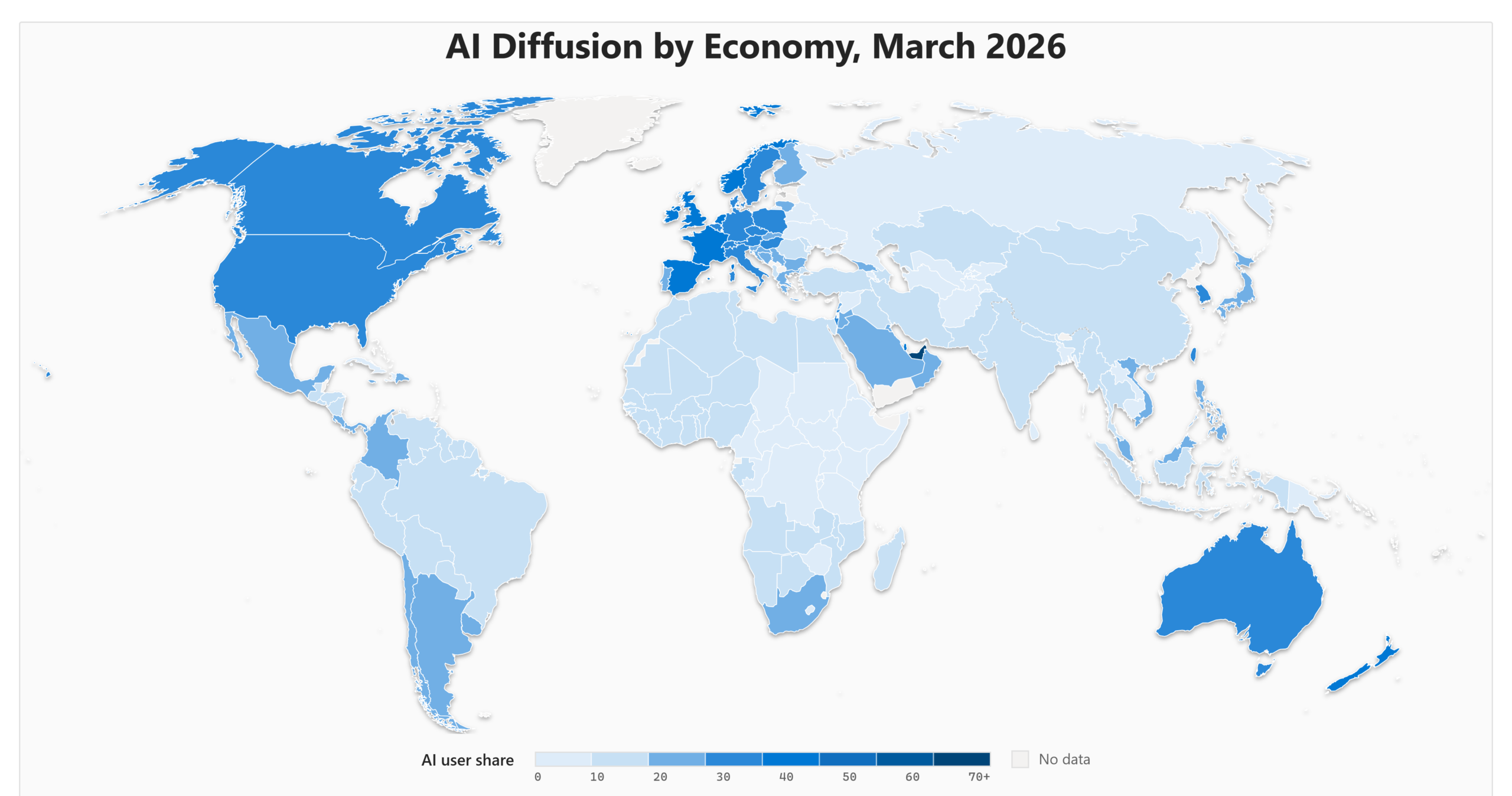
Key regional observations include:
| Region | Adoption Rate | Growth Rate | Key Drivers |
|---|---|---|---|
| North America | 28.5% | +1.2% | Enterprise adoption, AI assistants |
| Europe | 24.3% | +1.4% | Regulatory frameworks, privacy tools |
| Asia Pacific | 19.7% | +2.1% | Mobile AI, consumer applications |
| Latin America | 14.2% | +1.8% | SMB adoption, mobile-first |
| Africa | 8.6% | +2.4% | Mobile AI, financial inclusion |
Factors Driving Adoption Growth
Reduced Entry Barriers
The decrease in barriers to AI adoption has been a significant driver of growth. Several factors contribute to lower entry barriers:
Free Tier Availability: Major AI providers now offer comprehensive free tiers, allowing users to experience AI capabilities without initial investment. DeepSeek R1, Llama 3.3 70B, and Gemma 3 are available at zero cost on platforms like OpenRouter.
User-Friendly Interfaces: The evolution of conversational AI interfaces has made complex AI tools accessible to non-technical users. Natural language processing improvements enable intuitive interactions.
Cloud-Based Deployment: Cloud computing has eliminated the need for substantial infrastructure investments, allowing organizations to access AI capabilities through subscription models.
Enterprise Integration Acceleration
Enterprise adoption has accelerated significantly as organizations move beyond experimentation to full-scale integration. The driving factors include:
- Proven ROI in early pilot programs
- Decreasing implementation complexity
- Availability of industry-specific AI solutions
- Executive buy-in and strategic prioritization
Industry-Specific Adoption Patterns
Technology Sector
The technology sector leads in AI adoption, with usage rates exceeding 45% among knowledge workers. Common applications include code generation, debugging assistance, documentation creation, and architectural decisions.
Financial Services
Financial services organizations have embraced AI for risk assessment, fraud detection, and customer service applications. The industry's high data availability and regulatory pressure have created strong incentives for AI integration.
Healthcare
Healthcare adoption has grown from experimental programs to scaled deployments. AI applications in medical imaging, drug discovery, and administrative automation have demonstrated clear value propositions.
Manufacturing
Manufacturing has seen AI adoption in predictive maintenance, quality control, and supply chain optimization. The industrial internet of things (IIoT) combined with AI creates powerful optimization capabilities.
Challenges and Considerations
Digital Divide Concerns
The growing adoption gap between developed and developing regions raises concerns about digital divide implications. While mobile-first approaches help bridge gaps, disparities in infrastructure, education, and connectivity persist.
Quality and Accuracy Issues
As adoption scales, concerns about AI output quality become more prominent. Users must develop skills to evaluate AI-generated content, verify information, and understand limitations.
Privacy and Security
Privacy concerns continue to influence adoption patterns, particularly in regions with strict data protection regulations. Organizations must balance AI capabilities with compliance requirements.
Future Outlook
The trajectory of AI adoption suggests continued growth throughout 2026 and beyond. Several factors support this outlook:
Model Improvements: Continuous improvements in AI model capabilities expand use cases and improve user experiences.
Reducing Costs: API pricing continues to decrease, making AI accessible to more organizations.
Vertical Solutions: Industry-specific AI solutions reduce implementation complexity and accelerate time-to-value.
Education and Awareness: Growing awareness of AI capabilities drives demand across sectors.
Based on current trends, Microsoft projects global AI adoption could reach 25% of the working-age population by the end of 2026, representing continued substantial growth.
Conclusion
The Q1 2026 data from Microsoft's global AI diffusion report reveals a technology ecosystem maturing rapidly. The increase from 16.3% to 17.8% adoption represents not just numerical growth but a fundamental shift in how AI integrates into daily work and life. The regional variations highlight both opportunities and challenges in ensuring equitable access to AI benefits globally.
For organizations considering AI integration, the data suggests that competitive pressures will continue to mount as adoption grows. Early adopters who have already achieved scale are likely to maintain advantages, while organizations still in experimental phases should prioritize moving to production deployments.
The key takeaway is that AI adoption is no longer a question of if but when and how. The technology has demonstrated its value, the barriers continue to decrease, and the ecosystem supporting adoption grows stronger daily.
Related Articles
Anthropic's Explosive Growth: How Claude AI Surpassed OpenAI Revenue
Anthropic's CEO announces potential 80x growth in 2026, signaling a dramatic shift in the AI competitive landscape as Claude AI challenges OpenAI's market dominance.
AI Trends 2026: The Technologies Shaping Tomorrow
An in-depth analysis of the most significant AI trends driving innovation and transformation in 2026 and beyond.
Meta AI Employee Concerns: The Human Cost of Rapid AI Deployment
An examination of employee sentiment at Meta regarding AI implementation and the broader implications for tech workforce wellbeing in the age of rapid AI deployment.