
China's AI Divide: DeepSeek's Open-Source Path vs Alibaba's Proprietary Pivot
DeepSeek's R1 breakthrough triggered a frenetic year in AI, but Alibaba's move toward proprietary models raises concerns about China's open-source future. Explore the shifting dynamics of China's AI strategy.
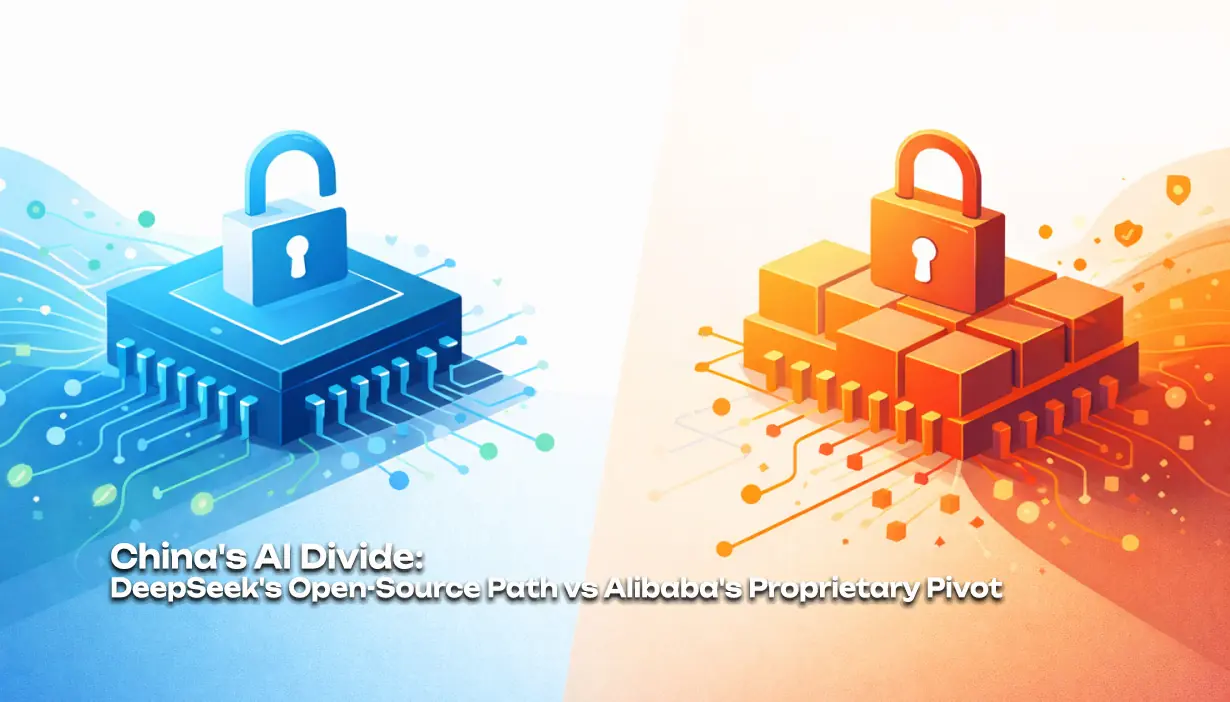
China's artificial intelligence landscape is undergoing a dramatic transformation that few predicted. When DeepSeek released its R1 reasoning model in January 2025, it sent shockwaves through the global AI industry, demonstrating that an open-source system could match proprietary offerings from American giants at a fraction of the cost. A frenetic year of AI development followed, with Chinese AI innovation stealing the spotlight. However, as 2026 unfolds, signs of a retreat are emerging. Alibaba's recent moves toward proprietary models, including the release of Qwen3.6-Plus as a closed system, signal a potential pivot away from the open-source approach that powered China's AI rise. This strategic divergence—DeepSeek's commitment to openness versus Alibaba's profit-focused proprietary direction—now defines the central fault line in Chinese AI development, with profound implications for the global AI ecosystem.
Introduction
The story of Chinese AI in 2025-2026 is one of unexpected reversal. For years, American companies dominated artificial intelligence, with OpenAI, Google, and Anthropic setting the agenda. Then came DeepSeek—a Chinese startup that fundamentally disrupted the industry's assumptions about computational requirements and open collaboration. The company's R1 model matched OpenAI's reasoning capabilities while training on a budget that AI researcher Andrej Karpathy called a "joke"—just $5.6 million worth of processors. Perhaps more significantly, DeepSeek released its models under permissive open-source licenses, allowing anyone to download, inspect, and deploy them.
For a brief moment, it seemed like China had found its path to AI dominance through openness. The DeepSeek approach demonstrated that open-source development could compete with—and potentially outperform—proprietary alternatives. But as 2026 has unfolded, this narrative has grown more complicated. Alibaba, the company many expected to lead China's open-source charge, has instead pivoted toward proprietary models. The April 2026 releases of Qwen3.5-Omni and Qwen3.6-Plus as closed systems mark a significant departure from the open approach that defined earlier Qwen releases.
This divergence raises urgent questions about China's AI future. Is the world's most populous nation retreating from the open-source approach that powered its recent successes? What does Alibaba's pivot mean for the global open-source AI movement? And can China's AI ambitions survive without the openness that characterized the DeepSeek breakthrough?
The DeepSeek Revolution
R1: The Model That Shook the Industry
When DeepSeek released its R1 reasoning model in January 2025, the AI industry responded with a mixture of disbelief and alarm. The model demonstrated reasoning capabilities that appeared to match OpenAI's flagship offerings—not through sheer computational scale, but through innovative training techniques that emphasized reasoning over raw parameter count. More significantly, DeepSeek released R1 as an open-weight model under the permissive MIT license, meaning anyone could download, inspect, modify, and deploy the system.
This approach stood in stark contrast to the American AI giants. OpenAI, despite its name, had long since abandoned meaningful openness, keeping its most capable models proprietary. Anthropic's Claude remained a closed system. Even Meta's open-source Llama came with significant restrictions. DeepSeek's decision to truly open its models represented a fundamental challenge to the industry's structure—a challenge that resonated particularly in China, where the company's success was seen as demonstrating a viable alternative path to AI dominance.
The impact was immediate and measurable. Within months, R1 became the most-liked open-source model on Hugging Face, the primary platform for sharing AI models. Chinese innovation accelerated as developers built upon DeepSeek's foundation, creating rapid iterations and distilled versions of the model. The open approach catalyzed an entire ecosystem.
V4: Extending the Open Legacy
In April 2026, DeepSeek extended its open-source lineup with the preview release of the V4 model. The release maintained the company's commitment to openness while demonstrating continued capability improvements. Perhaps most significantly, the company announced tight integration with Huawei's Ascend chips—a critical development given American export restrictions that have limited China's access to advanced AI processors.
This integration represents more than technical convenience. By supporting domestic chip architectures, DeepSeek is helping to build a more resilient AI ecosystem that doesn't depend on American hardware. The company's success demonstrates that Chinese AI can thrive even with restricted access to the most advanced chips, a finding with significant implications for the broader technology relationship between the two nations.
The Economics of Openness
DeepSeek's success challenges fundamental assumptions about AI economics. The company's claim that it trained the V3 model on just $5.6 million worth of processors—Karpathy's "joke of a budget"—suggests that the billions spent by American companies on AI training may not be necessary for competitive capability. If true, this has profound implications for the industry's structure. Open-source approaches may not just be viable alternatives but potentially superior paths to AI development.
The economic argument extends beyond training costs. Open-source models can be deployed flexibly, modified for specific applications, and refined through community contribution. Proprietary systems, by contrast, offer limited customization and create vendor lock-in. If open-source models can match proprietary capabilities, the economic case for proprietary AI weakens considerably.
Alibaba's Proprietary Pivot
The April 2026 Releases
Alibaba's April 2026 model releases marked a significant departure from the company's earlier approach. While previous Qwen models had been released under open-source licenses—contributing to an entire ecosystem of open Chinese AI—the company released Qwen3.5-Omni and Qwen3.6-Plus as proprietary systems. Access was limited to Alibaba's cloud platform and the company's chatbot interfaces.
This decision puzzled many observers. Qwen had become one of the world's most-downloaded open-source AI model families, creating an enormous ecosystem of developers and applications built on the open models. By closing these models, Alibaba was essentially abandoning the community it had helped create.
The timing was particularly notable. Just as DeepSeek was extending its open-source commitment with the V4 preview, Alibaba was closing its flagship models. The contrast could hardly have been starker—DeepSeek doubling down on openness just as Alibaba was retreating.
The Business Logic
Alibaba's pivot reflects a calculation about profit versus ecosystem development. Open-source models, while popular, create limited direct revenue. Companies must find other ways to monetize—through cloud services, support contracts, or premium features. Proprietary models, by contrast, can be sold directly, creating clearer revenue paths.
This business logic has growing importance for Alibaba. The company faces intensifying competition across its business lines—e-commerce, cloud computing, and AI. The company's leadership apparently concluded that proprietary models offered better revenue potential than the open-source approach that had defined earlier Qwen releases.
The Bloomberg reporting on Alibaba's strategy emphasizes "focus on profit"—the company's proprietary pivot is explicitly framed as a profit-seeking decision rather than a technical or philosophical one. This raises questions about whether other Chinese AI companies might follow the same logic, trading ecosystem development for direct revenue.
Mixed Signals
However, Alibaba's strategy isn't entirely clear. The company also released Qwen3.6-35B-A3B under the Apache 2.0 license in April 2026, maintaining some presence in the open-source space. This mixed approach—some models open, some closed—suggests the company is still figuring out its strategy rather than having committed definitively to either path.
This ambiguity contrasts with DeepSeek's consistent open-source commitment. Where DeepSeek has maintained a clear position—releasing all its models under open licenses—Alibaba's approach is harder to read. Is this the beginning of a full retreat from open-source, an experiment to test different business models, or simply a multi-pronged strategy that maintains options?
The Strategic Implications
Beijing's Dilemma
The divergence between DeepSeek and Alibaba represents a challenge for Chinese policy. Beijing has invested heavily in AI development, seeing artificial intelligence as a strategic domain where China should lead. The DeepSeek approach—open-source, cost-effective, independent of American chips—alignment well with national interests. Proprietary approaches, by contrast, create dependencies on particular companies and may exclude international collaboration.
A May 2026 Japan Times analysis argued that "Beijing can't quit 'open' AI"—suggesting political constraints on how far Chinese companies can retreat from the open-source approach. This analysis points to the strategic importance of open AI for China's technology ambitions. An open approach allows Chinese AI to build global ecosystems, attract international developers, and demonstrate technological leadership. Proprietary approaches, by contrast, may be more economically attractive but leave China dependent on particular company successes.
The DeepSeek-Alibaba divergence thus represents more than two different company strategies—it reflects fundamental questions about how China should pursue its AI ambitions. Should Chinese AI prioritize openness and ecosystem building, or proprietary profit extraction?
Global Competition Dynamics
The strategic choice has implications beyond China. DeepSeek's open-source success demonstrated that a different approach to AI development was possible—one that didn't require American computational advantages. By maintaining openness, China could build global coalitions of developers and researchers who contributed to Chinese AI ecosystems. Proprietary approaches, by contrast, keep Chinese AI dependent on domestic companies and markets.
American AI companies have watched these developments with interest. The success of open-source Chinese AI has complicated their competitive strategies. If open-source models can match proprietary capabilities, the case for proprietary development weakens. Some American companies have responded by accelerating their own open-source efforts; others have doubled down on proprietary advantages.
The DeepSeek-Alibaba divergence thus affects global AI competition. If China remains committed to open-source approaches, it may maintain competitive advantages in global developer communities. If more Chinese companies follow Alibaba's proprietary pivot, those advantages may erode.
The State of Chinese AI Innovation
Open-Source Leadership
Despite Alibaba's pivot, the broader Chinese AI ecosystem remains committed to open-source approaches. DeepSeek's continued leadership, combined with contributions from other Chinese AI projects, has made open-source AI a Chinese-dominated domain. The most popular open-source models on HuggingFace—the central platform for AI model sharing—are overwhelmingly Chinese in origin.
This dominance represents a significant achievement. Just two years ago, open-source AI was dominated by American companies, particularly Meta with its Llama family. Chinese models have not only caught up but surpassed their American competitors in popularity and capability. The transformation has been remarkable.
Application Leadership
Beyond model development, China leads in several AI application domains. A particularly notable example is autonomous vehicles, where Chinese company Inceptio leads globally in commercial autonomous truck miles. This application leadership demonstrates that Chinese AI innovation extends beyond model development to real-world deployment.
Chinese AI applications also dominate domestic markets in ways that American companies cannot match. Despite ongoing technology restrictions, Chinese AI has found applications in sectors ranging from manufacturing to healthcare. The combination of open-source model availability and domestic application deployment has created a vibrant AI ecosystem.
Hardware Constraints
American chip restrictions have constrained but not prevented Chinese AI development. The integration of models like DeepSeek V4 with Huawei's Ascend chips demonstrates alternative paths forward. While American restrictions have undoubtedly slowed Chinese AI development, they have not produced the "wall" that some predicted.
This resilience has implications for the effectiveness of technology restrictions. If Chinese AI can develop competitive capabilities with domestic chips, restrictions become less effective as competitive tools. The ongoing evolution of Chinese AI hardware and software suggests the technology relationship between the two nations will remain complicated.
Comparing DeepSeek and Alibaba AI Strategies
| Aspect | DeepSeek | Alibaba (Qwen) |
|---|---|---|
| Model Release Approach | Full open-source (MIT License) | Mixed: proprietary and open-source |
| Training Cost | ~$5.6M (V3) - remarkably efficient | Not publicly disclosed |
| Chip Integration | Huawei Ascend compatibility | Cloud and proprietary deployment |
| Market Position | Open-source leader | E-commerce to AI pivot |
| Strategy Focus | Ecosystem development | Profit optimization |
| 2025-2026 Impact | R1 disrupted global AI market | Qwen built largest Chinese model family |
| User Access | Downloadable, self-deployable | API/cloud-dependent |
Table 1: Strategic comparison between DeepSeek's open-source approach and Alibaba's proprietary pivot
The Future of China's AI Strategy
Potential Scenarios
Several trajectories remain possible for Chinese AI. The most optimistic open-source scenario sees continued DeepSeek leadership combined with broader Chinese commitment to openness, building global AI ecosystems centered on Chinese models. This approach maximizes global influence and maintains competitive pressure on American proprietary systems.
Alternatively, more Chinese companies might follow Alibaba's logic, prioritizing profit over ecosystem development. This would fragment the Chinese AI landscape, potentially reducing the sector's global influence even as individual company revenues grow.
A middle path—maintaining both proprietary and open-source offerings—might allow Chinese AI to capture both profits and ecosystem benefits. This is essentially Alibaba's current approach, though its long-term sustainability remains unclear.
Global AI Implications
Chinese AI's trajectory affects global development. The open-source approach pioneered by DeepSeek has demonstrated that competitive AI development doesn't require the massive computational resources of American giants. This has democratized AI development globally, allowing smaller organizations and less wealthy nations to participate in AI advancement.
Proprietary approaches, by contrast, maintain the industry's traditional structure—dominated by a few wealthy companies with proprietary advantages. If China's AI sector moves toward proprietary models, this may reduce global participation in AI development.
TheDeepSeek-Alibaba divergence will likely determine which path Chinese AI takes. DeepSeek's continued success would validate the open-source approach; Alibaba's profit-focused strategy would suggest the proprietary alternative may be more sustainable. The answer will shape AI globally.
Conclusion
The divergence between DeepSeek's open-source commitment and Alibaba's proprietary pivot defines the central question in Chinese AI strategy. What began as a unified narrative—China's open-source AI breakthrough—has become more complicated as 2026 unfolds. DeepSeek continues to extend its open approach, while Alibaba has pivoted toward profit-focused proprietary models, releasing flagship Qwen models as closed systems.
This divergence has implications beyond the two companies involved. China's AI strategy—whether it embraces openness for ecosystem development or prioritizes direct profit extraction—will shape the global AI landscape. An open-source China can build global coalitions and maintain competitive pressure on proprietary American systems. A proprietary China will be more economically successful individually but may lose the ecosystem advantages that defined its recent successes.
The stakes are enormous. AI is increasingly central to economic competitiveness, military capability, and social development. How China navigates this choice—and whether the DeepSeek approach or the Alibaba model proves more sustainable—will affect not just Chinese AI but global technological development.
The answer remains uncertain. What is clear is that the era when the world simply assumed American AI dominance—and Chinese AI as a perpetual follower—is definitively over. China now defines one of the central debates in global AI development: open or proprietary, ecosystem or profit, collaboration or control. The choice will shape AI's future.
Related Articles
The Open Source AI Landscape in 2026: Llama, Mistral, and Qwen Compared
As open-source AI models mature in 2026, developers face a crucial choice between Meta's Llama 4, Europe's Mistral 3, and China's Qwen 3.5. This comprehensive analysis examines capabilities, licensing, and use cases for each major player.

Claude Mythos 5: Anthropic's 10-Trillion Parameter Leap into Unknown Territory
An in-depth analysis of Anthropic's accidental leak revealing Claude Mythos 5, the world's first widely-recognized 10-trillion-parameter AI model, and what it means for the AI race.
DeepSeek V4 Preview: The Open-Source Model Closing the Gap with Frontier AI
DeepSeek V4 Preview and V4-Pro deliver GPT-5.5-comparable performance at 85% lower cost, with 1M token context and native agentic capabilities.