
Graph Neural Networks: Learning from Structured Data
How graph neural networks enable deep learning on connected data structures, from social networks to molecular systems.
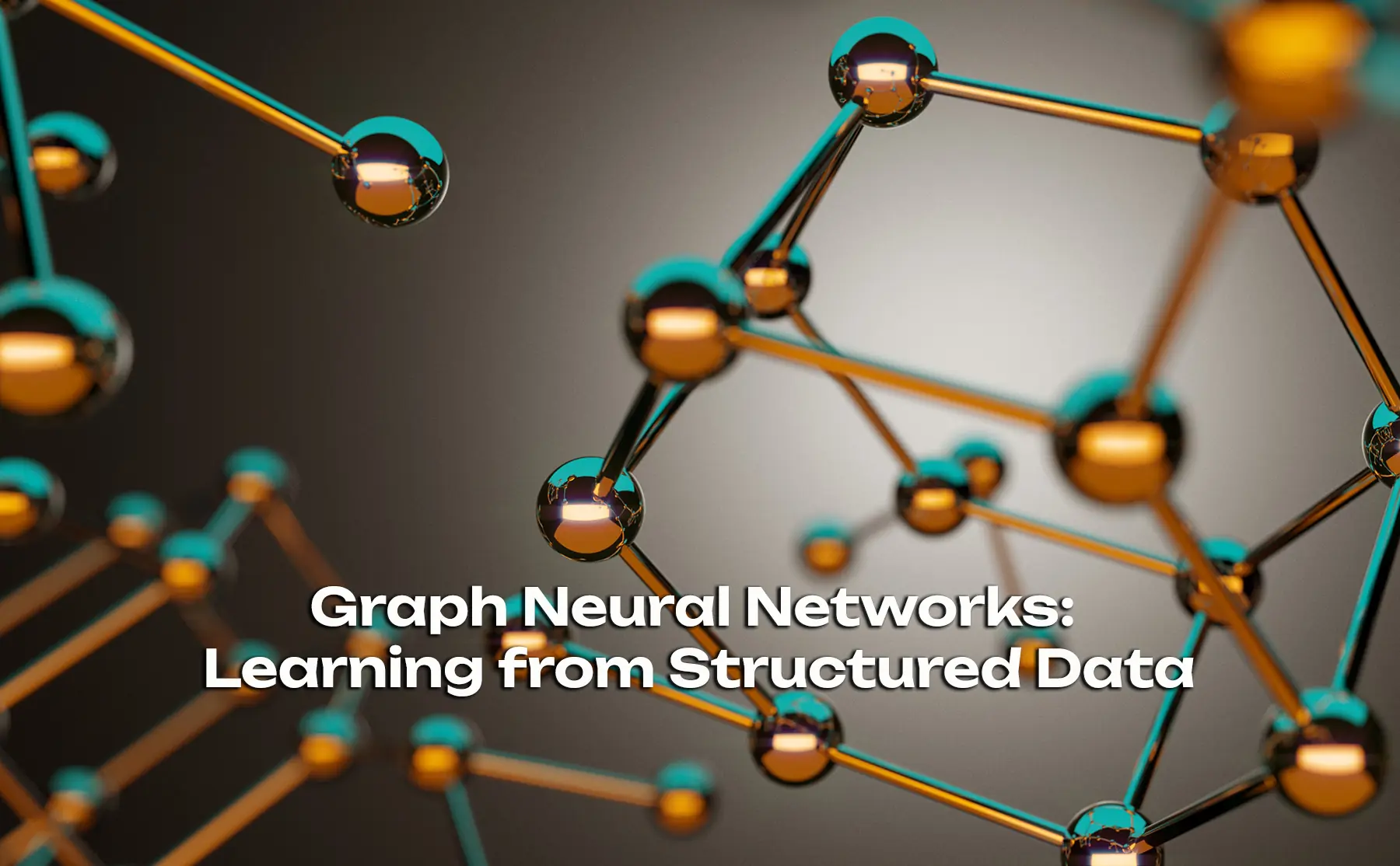
Traditional neural networks excel at processing Euclidean data—images, text, audio. But much of the world's data exists in non-Euclidean forms: social networks, molecular structures, transportation systems, and knowledge graphs. Graph Neural Networks (GNNs) provide a principled approach to learning from these connected data structures. This article explores GNN architectures, applications, and implementation patterns.
Introduction
Consider these data structures:
- Social networks: Users connected by friendships, followers, interactions
- Molecules: Atoms bonded together in complex 3D configurations
- Transportation: Cities connected by roads, flights, rail lines
- Knowledge graphs: Entities with typed relationships
- Financial networks: Transactions between accounts
Traditional deep learning models expect data in regular formats—vectors, matrices, or tensors. Graphs break these assumptions: variable numbers of nodes, arbitrary connectivity, no inherent ordering.
Graph Neural Networks solve this problem by learning representations that respect graph structure.
Understanding Graph Representations
Graph Components
A graph G = (V, E) consists of:
- Vertices (V): Nodes representing entities
- Edges (E): Connections between entities
- Optional features: Attributes on nodes and edges
Types of Graphs
| Type | Description | Examples |
|---|---|---|
| Directed | Edges have direction | Web links, follower relationships |
| Undirected | Edges symmetric | Social friendships |
| Weighted | Edges have scores | Road distances, bond strengths |
| Typed | Multiple edge types | Knowledge graph relations |
| Heterogeneous | Different node types | Different user account types |
Representing Graphs for Neural Networks
Graphs must be encoded as tensors for processing:
# Node features: (num_nodes, feature_dim)
node_features = torch.randn(num_nodes, feature_dim)

# Edge index: (2, num_edges)
edge_index = torch.tensor([[0, 1, 2],
                          [1, 2, 0]])

# Optional edge features: (num_edges, edge_feature_dim)
edge_features = torch.randn(num_edges, edge_feature_dim)
Graph Neural Network Architectures
Message Passing Neural Networks
The foundational GNN framework:
For each layer l = 1 to L:
    For each node v:
        Aggregate messages from neighbors
        Update node representation
Message passing equation:
def message_passing(node_features, edge_index):
    # For each edge, compute message from source to target
    messages = compute_message(source_features, target_features, edge_attr)

    # Aggregate messages to each node
    aggregated = scatter_sum(messages, target_node)

    # Update node representation
    new_features = update_function(aggregated)

    return new_features
GraphSAGE: Scalable Inductive Learning
GraphSAGE introduces sampling and aggregation:
class GraphSAGE(nn.Module):
    def __init__(self, input_dim, hidden_dim, output_dim):
        self.aggregate = MeanAggregator()
        self.update = nn.Linear(hidden_dim * 2, hidden_dim)
        self.transform = nn.Linear(input_dim, hidden_dim)

    def forward(self, x, edge_index):
        # Sample neighbors (for scalability)
        neighbors = sample_neighbors(edge_index, num_samples=5)

        # Aggregate neighbor features
        aggregated = self.aggregate(x, neighbors)

        # Concatenate with self features
        combined = torch.cat([x, aggregated], dim=-1)

        # Update
        return self.update(combined)
Graph Attention Networks (GAT)
GAT adds attention mechanisms:
class GraphAttentionLayer(nn.Module):
    def __init__(self, in_dim, out_dim, heads=4):
        self.heads = heads
        self.W = nn.Linear(in_dim, out_dim * heads)
        self.att = nn.Linear(out_dim * 2, 1)

    def forward(self, x, edge_index):
        # Transform features
        h = self.W(x).view(-1, self.heads, out_dim)

        # Compute attention scores
        source, target = h[edge_index[0]], h[edge_index[1]]
        e = self.att(torch.cat([source, target], dim=-1))
        a = softmax(e, edge_index[1])

        # Weighted aggregation
        out = scatter_add(a * source, edge_index[1])
        return out
Comparative Analysis
| Architecture | Inductive | Scalable | Attention | Best For |
|---|---|---|---|---|
| GCn | No | Moderate | No | Small transductive |
| GraphSAGE | Yes | Yes | No | Large-scale inductive |
| GAT | Yes | Moderate | Yes | Attention-weighted |
| Transformer-G | Yes | Moderate | Yes | State-of-the-art |
Applications of Graph Neural Networks
1. Molecular Property Prediction
GNNs excel at molecular analysis:
- Drug discovery: Predict binding affinity
- Material design: Predict material properties
- Toxicity prediction: Assess safety profiles
Molecule → GNN → Property prediction
[Atom features, Bond features] → [Learn representation] → [Binding affinity, IC50, etc.]
2. Social Network Analysis
- Recommendation: Friend/content recommendations
- Fraud detection: Anomalous account patterns
- Influence modeling: Identify key influencers
3. Knowledge Graph Reasoning
- Entity resolution: Link prediction
- Question answering: Multi-hop reasoning
- Recommendation: Knowledge-enhanced recommendations
4. Transportation and Logistics
- Traffic prediction: Flow forecasting
- Route optimization: Path planning
- Delivery scheduling: Logistics optimization
Implementation with PyTorch Geometric
Basic GNN Implementation
import torch
from torch_geometric.nn import GCNConv, global_mean_pool

class GNN(torch.nn.Module):
    def __init__(self, input_dim, hidden_dim, output_dim, num_layers):
        super().__init__()
        self.convs = nn.ModuleList()
        self.convs.append(GCNConv(input_dim, hidden_dim))
        for _ in range(num_layers - 2):
            self.convs.append(GCNConv(hidden_dim, hidden_dim))
        self.convs.append(GCNConv(hidden_dim, output_dim))
        self.dropout = nn.Dropout(0.5)

    def forward(self, x, edge_index, batch=None):
        for conv in self.convs[:-1]:
            x = conv(x, edge_index)
            x = F.relu(x)
            x = self.dropout(x)

        x = self.convs[-1](x, edge_index)

        # Graph-level pooling
        if batch is not None:
            x = global_mean_pool(x, batch)

        return x
Training Loop
def train(model, data, optimizer, criterion):
    model.train()
    optimizer.zero_grad()

    out = model(data.x, data.edge_index, data.batch)
    loss = criterion(out[data.train_mask], data.y[data.train_mask])

    loss.backward()
    optimizer.step()

    return loss.item()
Challenges and Future Directions
Current Challenges
| Challenge | Description | Mitigation |
|---|---|---|
| Scalability | Large graphs | Sampling, clustering |
| Over-smoothing | Deep GNNs merge | Skip connections, identity |
| Expressiveness | WL test limitations | Higher-order neighborhoods |
| Heterogeneity | Diverse node types | Heterogeneous GNNs |
Emerging Research
- Graph Transformers: Attention over graph structure
- Continuous GNNs: Diffusion-based methods
- Temporal Graphs: Dynamic graph evolution
- Causal GNNs: Incorporating causal structure
Conclusion
Graph Neural Networks unlock deep learning capabilities on structured data that traditional models cannot handle. From molecular discovery to social network analysis, GNNs provide a principled approach to learning from connected data.
The field continues to evolve rapidly, with new architectures pushing the boundaries of what's possible. For practitioners, understanding GNNs opens doors to applications across science, industry, and social systems that depend on structured relationships.
Related Articles
The Open Source AI Landscape in 2026: Llama, Mistral, and Qwen Compared
As open-source AI models mature in 2026, developers face a crucial choice between Meta's Llama 4, Europe's Mistral 3, and China's Qwen 3.5. This comprehensive analysis examines capabilities, licensing, and use cases for each major player.
Claude Mythos 5: Anthropic's 10-Trillion Parameter Leap into Unknown Territory
An in-depth analysis of Anthropic's accidental leak revealing Claude Mythos 5, the world's first widely-recognized 10-trillion-parameter AI model, and what it means for the AI race.

China's AI Divide: DeepSeek's Open-Source Path vs Alibaba's Proprietary Pivot
DeepSeek's R1 breakthrough triggered a frenetic year in AI, but Alibaba's move toward proprietary models raises concerns about China's open-source future. Explore the shifting dynamics of China's AI strategy.