
AI in Medical Imaging: How Machine Learning is Accelerating Radiology
Machine learning algorithms are transforming radiology by detecting patterns in X-rays, MRIs, and CT scans with unprecedented accuracy, helping radiologists diagnose faster and more accurately.
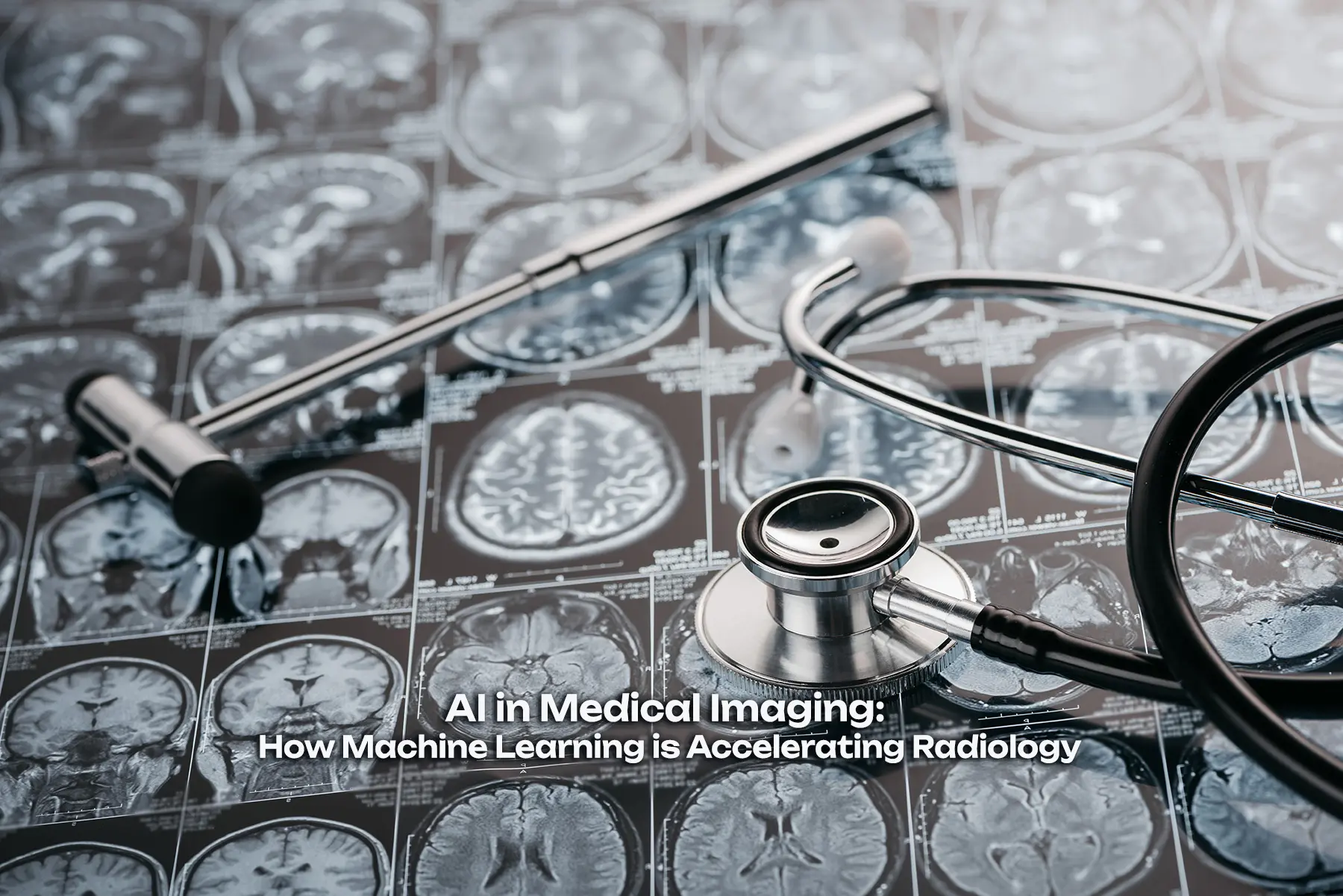
Medical imaging generates vast amounts of data daily — X-rays, MRI scans, CT images, and pathology slides that radiologists must analyze under time pressure. AI-powered image analysis is emerging as a transformative force in diagnostic radiology, helping clinicians detect conditions ranging from lung nodules to diabetic retinopathy with accuracy that matches or exceeds human specialists. This article explores the state of AI in medical imaging, its clinical applications, regulatory landscape, and what the future holds for AI-assisted diagnostics.
Introduction
Radiology is fundamentally an image interpretation task — and image interpretation is precisely where deep learning excels. Over the past decade, convolutional neural networks trained on millions of labeled medical images have achieved remarkable performance on tasks from detecting pneumonia in chest X-rays to identifying melanomas in dermatology photographs.
The question is no longer whether AI can analyze medical images. The question is how it integrates into clinical workflows, how its outputs are validated, and how it changes the relationship between radiologists and the technology they use.
How AI Analyzes Medical Images
Deep Learning Architecture
Medical image AI typically employs convolutional neural networks (CNNs) or vision transformers trained on large annotated datasets. These models learn to recognize visual features associated with specific conditions — the irregular margins of a tumor, the opacity patterns of pneumonia, the microaneurysms characteristic of diabetic retinopathy.
Training requires massive datasets of labeled images — often hundreds of thousands or millions — curated by expert radiologists. The quality of the training data directly determines the model's clinical utility.
Modality-Specific Applications
Different imaging modalities present unique challenges and opportunities:
| Modality | Primary AI Applications | Key Challenges |
|---|---|---|
| X-Ray | Lung nodule detection, fracture identification, pneumonia screening | Overlapping structures, subtle findings |
| CT Scan | Stroke detection, colorectal polyp identification, lung cancer screening | High-dimensional data, radiation dose considerations |
| MRI | Brain tumor segmentation, prostate cancer detection, cardiac imaging | Long scan times, variable protocols |
| Ultrasound | Fetal anomaly detection, cardiac function assessment | Operator dependence, real-time analysis needs |
| Pathology | Cancer grading, tissue classification, biomarker quantification | Whole-slide imaging scale, staining variability |
Clinical Applications in Practice
Cancer Detection and Screening
AI has shown particular promise in cancer detection, where early identification dramatically improves outcomes.
Lung Cancer Screening: Low-dose CT screening with AI assistance has been shown to reduce false positives by 11% while improving sensitivity for small nodules. Models like those developed by Google Health have demonstrated performance exceeding radiologists in identifying lung cancers in early stages.
Breast Cancer Screening: AI systems for mammogram analysis are among the most advanced in clinical deployment. Studies show AI can reduce false negatives by 9.4% while cutting the workload for radiologists by 57%.
Pathology: Digital pathology AI helps pathologists grade cancers and identify relevant biomarkers, reducing diagnostic variability and accelerating turnaround times.
Neurological Applications
Stroke is a time-critical condition where AI is making a measurable clinical difference. AI-powered CT analysis can identify large vessel occlusions within seconds, alerting stroke teams and accelerating treatment decisions.
Brain MRI analysis AI quantifies white matter lesions, brain atrophy, and cortical thickness — providing objective measurements that track disease progression in conditions like multiple sclerosis and Alzheimer's disease.
Cardiovascular Imaging
AI assists in echocardiography by automating ejection fraction calculation, a key measure of heart function. It also analyzes cardiac CT scans to assess coronary artery calcium scores and identify plaques that may be at risk of rupture.
Accuracy and Performance Comparisons
| Task | AI System Accuracy | Expert Radiologist Baseline | Notes |
|---|---|---|---|
| Diabetic Retinopathy Detection | 97.5% sensitivity | ~90% sensitivity | FDA-approved systems in use |
| Lung Nodule Detection | 94.4% sensitivity | ~90% sensitivity | Low-dose CT studies |
| Mammography Screening | Matches radiologist pairs | AUC ~0.94 | Reduces workload significantly |
| Skin Cancer Classification | Matches dermatologists | AUC ~0.96 | Dermatoscopy images |
| Stroke Detection (CT) | < 1 minute analysis | Minutes to hours | Critical time savings |
Regulatory Landscape
FDA Clearance Pathways
In the United States, AI medical devices fall under FDA oversight. The agency has established several pathways for AI/ML-based software:
- 510(k) clearance for devices that are substantially equivalent to a predicate device
- De Novo classification for novel devices without a predicate
- Premarket Approval (PMA) for high-risk devices requiring clinical evidence
By 2026, the FDA has cleared over 900 AI/ML-enabled medical devices, with radiology accounting for the majority.
EU Medical Device Regulation (MDR)
The European Union's MDR, fully in force since May 2021, classifies AI medical devices according to risk level. High-risk applications like diagnostic AI require conformity assessment by notified bodies before market entry.
Continuous Learning and Real-World Performance
A key regulatory challenge is ensuring AI systems continue performing as expected after deployment. The FDA's proposed framework for continuously learning AI requires manufacturers to monitor real-world performance, report significant changes, and implement risk management practices.
Integration into Clinical Workflows
Triage and Prioritization
One of the most immediate clinical benefits is AI-powered triage. By flagging the most urgent findings first, AI ensures radiologists address critical cases — strokes, pulmonary emboli, pneumothoraces — before routine studies.
Augmentation, Not Replacement
The prevailing model is AI as a second reader or decision support tool, not an autonomous diagnostician. AI highlights potential abnormalities; the radiologist confirms or dismisses. This model leverages AI's consistency and tireless attention while preserving human judgment for complex cases.
Reporting and Communication
AI is also being integrated into radiology reporting systems, auto-populating structured reports with measurements and flagging significant changes from prior studies. This reduces administrative burden and improves report quality.
Challenges and Limitations
Data Quality and Generalizability
AI models trained on data from one institution or population may not generalize well to others. Differences in imaging equipment, patient demographics, and acquisition protocols can degrade performance. Multi-center validation studies are essential before clinical deployment.
Explainability
Many high-performing AI models are effectively black boxes. Clinicians need to understand why a model flagged a finding — not just that it did. Explainable AI techniques like attention maps and saliency overlays are helping, but there's still a gap between model confidence and human understanding.
Liability and Accountability
When AI and radiologist disagree, who is responsible? This question remains unresolved. Clear protocols for human-AI disagreement, documentation standards, and liability frameworks are needed as AI becomes more prevalent.
Underrepresentation in Training Data
Models trained predominantly on data from certain demographics may underperform for others. Ensuring diverse, representative training datasets is both an ethical imperative and a practical requirement for robust clinical AI.
The Future
Foundation Models for Medical Imaging
Just as language models have transformed NLP, foundation models trained on massive medical imaging datasets are enabling transfer learning across modalities and institutions. These models can be fine-tuned on smaller datasets for specific tasks, accelerating development of new AI applications.
Real-Time Intraoperative Guidance
AI is moving beyond diagnostic interpretation into the operating room. Real-time analysis of surgical video feeds can identify critical structures, predict bleeding, and guide surgeons — a frontier with enormous potential and significant technical challenges.
Multi-Modal Integration
The most powerful diagnostic AI will integrate information across modalities — combining imaging findings with lab results, genomic data, clinical notes, and patient history. Multi-modal AI architectures are beginning to enable this integration.
Conclusion
AI in medical imaging is no longer experimental — it is a clinical reality, deployed in hospitals and imaging centers worldwide. The technology's ability to detect patterns, prioritize urgent findings, and reduce diagnostic variability offers genuine benefits for patients and radiologists alike.
But clinical deployment requires more than algorithmic accuracy. It demands rigorous validation across diverse populations, thoughtful integration into existing workflows, clear regulatory frameworks, and ongoing monitoring of real-world performance. The path forward is not fully automated radiology but AI-augmented radiology — technology that enhances the expertise of trained clinicians rather than attempting to replace it.
The radiologist of 2030 will likely spend less time searching for abnormalities and more time synthesizing complex findings, communicating with referring physicians, and managing the cases that require human judgment. AI will not replace the radiologist; it will make the radiologist more valuable.
Related Articles
AI in Healthcare: Medical Diagnosis and Treatment Applications
How artificial intelligence is transforming healthcare — from medical imaging analysis to drug discovery and personalized treatment recommendations.
AI Diagnostic Platforms: How MIT-Spinout Technology is Changing Disease Detection
MIT spinouts are creating AI-driven platforms to transform disease diagnosis and treatment. These technologies are enabling healthcare systems to achieve the 'quadruple aim' of democratized care, standardized diagnostics, precision therapeutics, and precision medicine.