
Building Production-Ready Agentic AI: The ADLC Framework for Enterprise Success
The ADLC Framework provides a structured approach to building, deploying, and managing autonomous AI agents in enterprise environments. Here's how it works.
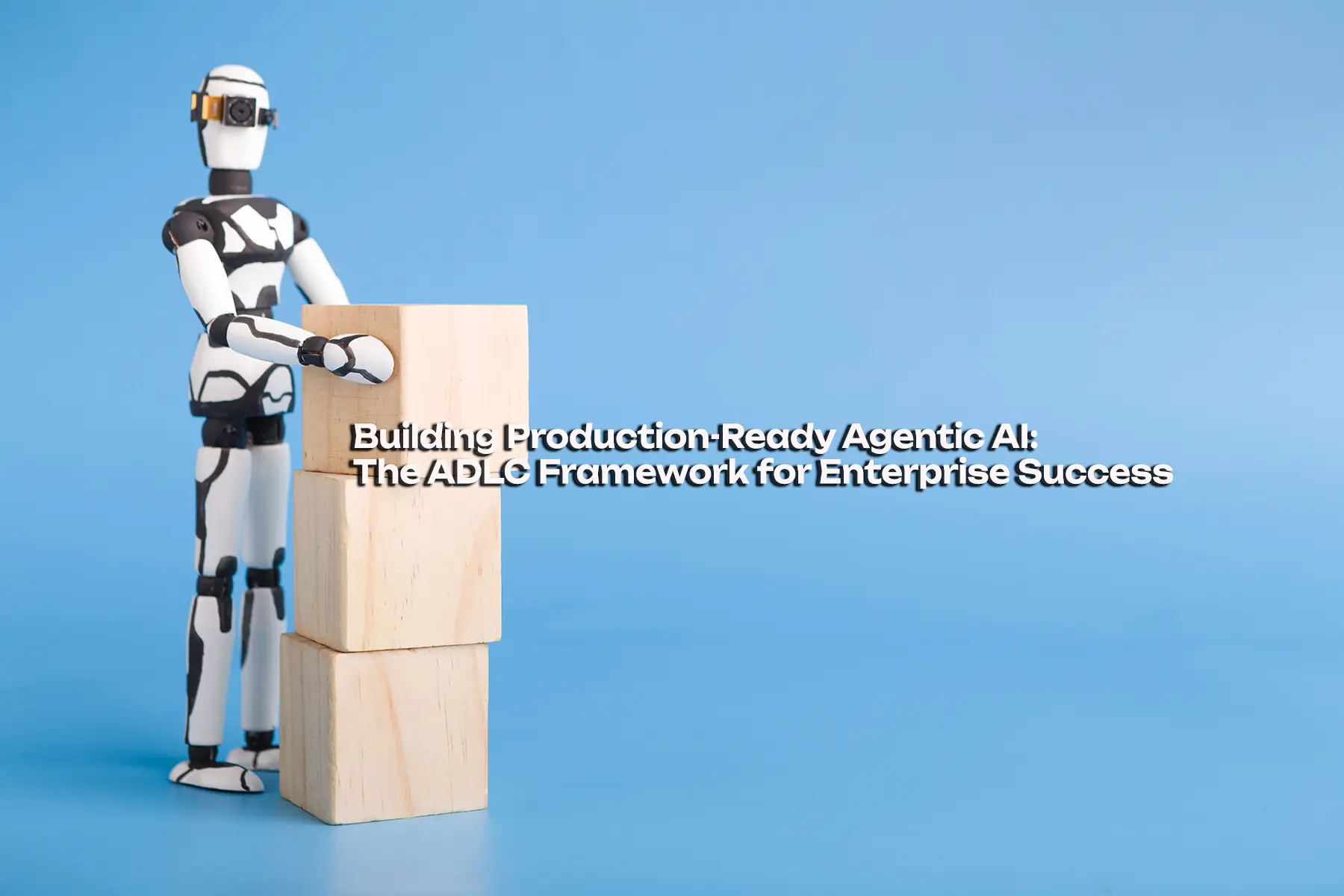
Agentic AI — autonomous systems that plan, act, and adapt without continuous human intervention — represents the next frontier of enterprise automation. Yet building these systems for production environments is far more complex than deploying a language model API. The ADLC Framework (Architecture, Development, Lifecycle, Control) provides a structured methodology that addresses the unique challenges of agentic AI: multi-step reasoning, tool use, real-world action, and ongoing governance. This article explores each pillar of the framework and provides practical guidance for enterprise teams embarking on agentic AI initiatives.
Introduction
The buzz around AI agents has reached a fever pitch in 2026. Every major technology vendor, from cloud providers to enterprise software companies, is announcing agentic capabilities. The promise is compelling: autonomous AI systems that can browse the web, write and execute code, manage databases, send emails, and orchestrate complex workflows — all with minimal human oversight.
But enterprise reality is more sobering. According to Gartner's 2026 Hype Cycle for Agentic AI, 40% of agentic AI projects are at risk of failure by 2027, primarily due to messy governance and unclear return on investment. Only 17% of organizations have actually deployed AI agents to date, even though more than 60% expect to do so within two years.
The gap between ambition and execution is wide. Closing it requires more than just better models — it requires a structured approach to building, deploying, and managing autonomous AI systems. That is the purpose of the ADLC Framework.
The ADLC Framework: An Overview
The ADLC Framework organizes enterprise agentic AI development into four interconnected pillars:
| Pillar | Focus | Key Activities |
|---|---|---|
| Architecture | System design and infrastructure | Agent design, tool integration, memory systems, communication protocols |
| Development | Building and testing agents | Prompt engineering, fine-tuning, simulation testing, sandbox environments |
| Lifecycle | Managing agents over time | Versioning, monitoring, updating, scaling, retirement |
| Control | Governance and safety | Access control, output validation, audit trails, intervention mechanisms |
Each pillar addresses a distinct set of challenges that enterprise teams must navigate to move from proof-of-concept to production.
Architecture: Designing Agents for Enterprise Use
The architectural decisions made at the outset of an agentic AI project have long-lasting consequences. A well-designed agent architecture provides the foundation for everything that follows.
Agent Design Patterns
Enterprise agents typically fall into one of three architectural patterns:
| Pattern | Description | Best For |
|---|---|---|
| Single-Agent | One agent handles all tasks | Simple, focused use cases |
| Multi-Agent | Multiple specialized agents collaborate | Complex workflows requiring diverse capabilities |
| Hierarchical | Orchestrator agent delegates to sub-agents | Large-scale enterprise operations |
Most production enterprise deployments converge on hierarchical multi-agent architectures, where a primary orchestrator manages specialized agents for different domains — finance, operations, customer service, engineering.
Tool Integration
The power of agentic AI comes from its ability to use tools — APIs, databases, code interpreters, web browsers, file systems. In the enterprise context, tool integration requires careful design:
- Security boundaries: Agents must operate within clearly defined permission scopes
- Auditability: Every tool call should be logged for compliance and debugging
- Fallback mechanisms: What happens when a tool is unavailable or returns an error?
- Rate limiting: Enterprise APIs impose usage limits; agents must respect them
The Model Context Protocol (MCP), introduced by Anthropic, is emerging as a standard for tool definition and integration, providing a vendor-neutral way to connect agents with the tools they need.
Memory Systems
Unlike stateless API calls, agentic AI requires persistent memory to maintain context across interactions. Enterprise memory systems must address:
- Short-term memory: Conversation context within a session
- Long-term memory: Knowledge accumulated over time (learned facts, preferences, patterns)
- Shared memory: Information accessible across multiple agents in a multi-agent system
- Privacy and security: Sensitive data in memory requires encryption and access controls
Google's TurboQuant breakthrough in LLM memory compression, announced in early May 2026, is particularly relevant here — more efficient memory systems enable agents to maintain richer context without proportional increases in computational cost.
Development: Building Agents That Actually Work
Development is where most agentic AI projects stumble. The transition from a compelling demo to a reliable production system is notoriously difficult.
Prompt Engineering for Agentic Behavior
Agentic AI requires a different approach to prompt engineering than static language model use. Key principles include:
- Explicit goal decomposition: Agents need clear instructions on how to break complex tasks into steps
- Tool use guidelines: When and how to call tools, error handling, retry logic
- Self-reflection prompts: Encouraging agents to evaluate their own outputs before acting
- Constraint specification: Clear boundaries on what the agent can and cannot do
Simulation and Testing
Testing agentic AI is fundamentally harder than testing deterministic software. Agents can take many different paths to complete a task, and edge cases are often discovered only in production. Enterprise teams should invest in:
- Simulation environments: Replay realistic scenarios to validate agent behavior
- Adversarial testing: Probe for failure modes, unexpected tool use, and prompt injection vulnerabilities
- A/B testing frameworks: Compare agent strategies without full production rollout
- Regression testing: Ensure agent updates don't break previously working behaviors
Cloudflare's Dynamic Workers, which use V8 Isolates to create 100x faster sandbox environments than containers, offer a compelling infrastructure option for simulation and testing — agents can be executed in isolated environments that start in milliseconds rather than seconds.
Fine-Tuning for Enterprise Domains
General-purpose models provide a strong foundation, but enterprise agents typically benefit from domain-specific fine-tuning. A financial services agent might be fine-tuned on regulatory documents, internal policies, and historical decision patterns. A customer service agent might learn company-specific terminology, product knowledge, and escalation procedures.
The tradeoff is maintenance burden: a fine-tuned model requires ongoing updates as the domain evolves, whereas a general model absorbs new knowledge through context.
Lifecycle: Managing Agents Over Time
Agentic AI systems are not "deploy and forget" — they require active lifecycle management throughout their operational lifetime.
Versioning and Rollback
Like any software system, agentic AI requires versioning. But the versioning challenge is compounded because the agent's behavior depends on multiple components: the base model, fine-tuned weights, system prompts, tool configurations, memory state, and external dependencies.
A rigorous versioning strategy should cover:
- Model version: Which base model and fine-tuning iteration is deployed?
- Configuration version: What system prompts, tool definitions, and parameters are active?
- Knowledge version: What data is in long-term memory?
- Dependency version: What APIs and services does the agent depend on?
Monitoring and Observability
Enterprise agents generate significant operational telemetry. Key metrics to monitor include:
| Metric Category | Specific Metrics |
|---|---|
| Performance | Task completion rate, average steps per task, time-to-completion |
| Quality | Accuracy of outputs, frequency of self-correction, escalation rate |
| Safety | Unauthorized tool access attempts, policy violations, output anomalies |
| Cost | Token consumption, API calls, compute hours |
| Health | Error rates, timeout rates, memory usage |
Scaling Considerations
Agentic AI has scaling challenges distinct from traditional software:
- Concurrent agent execution: Multiple agents running simultaneously create infrastructure demand spikes
- Memory growth: Long-running agents accumulate memory that must be managed
- Tool bottleneck: Shared tools (e.g., a single CRM API) become throughput limits
- Cost scaling: Each agent step consumes tokens and API calls, making cost prediction difficult
Control: Governance and Safety
The "Control" pillar is where enterprise agentic AI differs most sharply from consumer AI. Enterprises cannot afford to deploy autonomous systems without robust governance.
Access Control and Permissions
Agents should operate on the principle of least privilege — granted only the access necessary to perform their assigned tasks. This means:
- Role-based access: Agents inherit permissions from their assigned role, not the user who initiated them
- Tool-level permissions: Specific permissions for each tool (read-only vs. read-write database access, for example)
- Temporal constraints: Time-bounded permissions that expire after a defined window
- Audit logging: Every action an agent takes should be logged with sufficient context to reconstruct what happened
Output Validation
Agents can and do make mistakes. Enterprise deployments require output validation mechanisms:
- Rule-based validation: Hard constraints on outputs (e.g., output must be valid JSON, no disallowed content)
- LLM-based validation: Using a separate model to review the agent's outputs before they're acted upon
- Human-in-the-loop checkpoints: Critical decisions require human approval before execution
- Contradiction detection: Comparing agent outputs against known facts or policies
Ethical and Compliance Considerations
Agentic AI raises novel ethical and compliance questions:
- Accountability: Who is responsible when an autonomous agent makes a mistake?
- Transparency: Do enterprises need to disclose when AI agents act on behalf of the company?
- Bias and fairness: Do agents trained on historical data perpetuate existing biases?
- Regulatory compliance: Existing regulations (GDPR, HIPAA, SOX) weren't written with autonomous agents in mind — new compliance frameworks are needed
The Path Forward: Getting Started with ADLC
For enterprise teams ready to move beyond proof-of-concept, the ADLC Framework offers a structured path:
- Start with Architecture: Define the agent's scope, choose the right pattern (single vs. multi-agent), and design the tool integration strategy before writing any prompts.
- Invest in Development rigor: Build comprehensive test suites, simulation environments, and fine-tuning pipelines. The upfront investment pays dividends in production stability.
- Plan for Lifecycle from day one: Versioning, monitoring, and rollback mechanisms should be designed into the system, not bolted on later.
- Establish Control before deployment: Governance, permissions, and safety mechanisms are not optional — they are prerequisites for enterprise deployment.
The 40% failure rate for agentic AI projects is not inevitable. With a structured framework and disciplined execution, enterprises can build autonomous AI systems that deliver real value without unacceptable risk.
Conclusion
Agentic AI represents a genuine paradigm shift in what AI systems can do — and what enterprises can automate. But realizing that potential requires moving beyond the excitement of demos and confronting the hard work of production engineering. The ADLC Framework provides a structured methodology for this journey: starting with solid architecture, investing in rigorous development, planning for full lifecycle management, and establishing robust control mechanisms before deployment.
Enterprises that embrace this structured approach will be far better positioned to join the minority of organizations that successfully deploy agentic AI at scale — rather than contributing to the 40% that fail.
Related Articles

AI Manufacturing 2026: Smart Factories and the Industrial AI Revolution
Artificial intelligence is transforming manufacturing in 2026, with smart factory adoption hitting 47% globally and AI delivering 31% efficiency gains across the industrial sector.
Gartner 2026 Hype Cycle for Agentic AI What Enterprises Need to Know
Gartner's 2026 Hype Cycle for Agentic AI reveals only 17% of organizations have deployed AI agents, while 60% expect to deploy within two years. Here's what enterprise leaders need to know.
AI Agents in the Workplace: From Concept to Enterprise Deployment
Explore how autonomous AI agents are being deployed in enterprise environments for automation, decision support, and workflow orchestration.