
AI Observability: Monitoring Models in Production
Why traditional monitoring tools fall short for AI systems and how modern observability platforms are evolving to track model behavior, detect drift, and ensure AI reliability at scale.
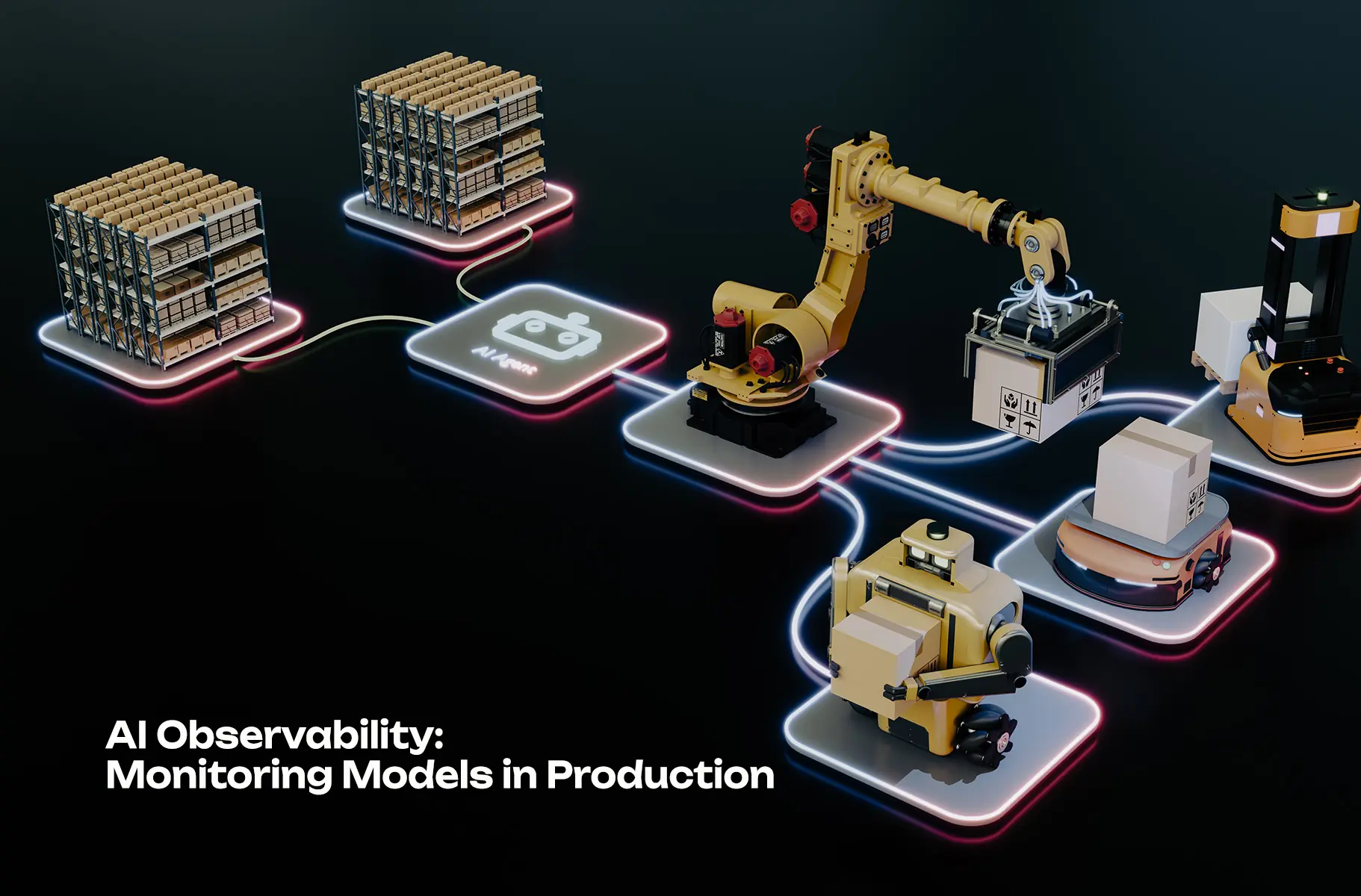
Deploying a machine learning model to production is only the beginning. Unlike traditional software, where behavior is fully determined by written code, AI models can behave unpredictably as the world around them changes. Data drifts, user behaviors evolve, and models that performed perfectly last month may begin degrading today. AI observability — the ability to understand, monitor, and debug AI systems in production — has emerged as one of the most critical disciplines in the AI engineering stack. This article explores the architecture, tools, and best practices for building robust AI observability systems.
Introduction
Software engineers have long embraced observability as a core discipline. Logs, metrics, and traces form the three pillars of traditional application observability, enabling teams to understand exactly what their systems are doing and why. When a web server starts returning errors, the observability stack tells you which requests failed, which components were involved, and often — what went wrong.
AI systems break this model. A model that accepts the same input can produce different outputs at different times — not because of a bug, but because the model's behavior is shaped by patterns learned during training. When the distribution of real-world inputs shifts, the model's outputs may degrade silently, without any error message or exception.
This is the fundamental challenge of AI observability: understanding and monitoring a system whose behavior emerges from learned patterns rather than explicit rules.
The Unique Challenges of AI Observability
Beyond Traditional Monitoring
Traditional monitoring tracks well-defined, measurable quantities: response time, error rate, CPU utilization, memory consumption. These metrics are deterministic — the same measurement taken twice under the same conditions produces the same value.
AI model behavior is fundamentally different. A model's output depends on its input, its internal learned parameters, and often randomness introduced during inference (temperature sampling, dropout, etc.). This creates a monitoring challenge with several unique dimensions:
- Input distribution monitoring: Are the types of queries changing over time?
- Output quality tracking: Are model responses remaining accurate and helpful?
- Latency management: Are inference times acceptable at scale?
- Cost monitoring: Is token consumption within budget?
- Behavioral drift detection: Has the model's decision-making patterns shifted?
Each dimension requires different tooling and different response protocols.
The Drift Problem
Concept drift is perhaps the most insidious challenge in AI production systems. It occurs when the relationship between input data and the target variable changes over time. A spam classifier trained on last year's spam patterns may struggle with new spam tactics. A recommendation engine trained on historical user behavior may fail to adapt to shifts in user preferences.
Drift can manifest in several forms:
| Drift Type | Description | Example |
|---|---|---|
| Covariate Drift | Input distribution changes | Users start asking questions in a new language |
| Prior Probability Drift | Class balance shifts | Spam ratio changes from 30% to 60% |
| Concept Drift | Relationship between input and output changes | Phrases that were "urgent" are now "spam" |
| Label Drift | Ground truth definitions change | New product categories in a classification model |
Detecting these drifts requires continuous statistical monitoring — comparing current data distributions against baseline distributions captured during training or a known-good operational period.
Core Components of an AI Observability Stack
Real-Time Input Monitoring
The first line of defense in AI observability is understanding what your model is actually seeing. Input monitoring captures:
- Distribution of input features: Are inputs within the expected range?
- Novelty detection: Are inputs significantly different from training data?
- Feature statistics: Mean, variance, and distribution of key features over time
Tools like WhyLabs, Arize, and Fiddler provide dashboards that visualize input distributions and alert when significant shifts occur. For LLM-based systems, this extends to monitoring prompt patterns, conversation lengths, and topic distributions.
Output Quality Tracking
Measuring output quality is challenging because, unlike traditional software, AI outputs don't have clear right-or-wrong answers. Instead, observability platforms use several approaches:
- Human feedback loops: Collecting thumbs-up/thumbs-down ratings from users
- Automated evaluation: Running outputs through separate quality assessment models
- A/B testing: Comparing model versions against each other in production
- Behavioral metrics: Tracking downstream outcomes (did the user follow the AI's recommendation?)
- Reference comparison: Comparing outputs against a golden dataset of known-good responses
Cost and Token Tracking
For LLM-based systems, token consumption is both a cost driver and a proxy for complexity. Observability platforms track:
- Token consumption per request: Average, P50, P95, P99
- Cost per query: At current API pricing, what is each interaction costing?
- Batch vs. real-time costs: Cost differences between inference types
- Prompt optimization impact: How do prompt changes affect token usage?
As AI systems scale, cost observability becomes as important as performance observability.
Tooling Landscape
The AI observability market has exploded with solutions targeting different layers of the stack:
| Category | Tools | Primary Focus |
|---|---|---|
| End-to-end platforms | Arize AI, WhyLabs, Fiddler | Full-stack model monitoring |
| LLM-specific | Braintrust, PromptLayer, Helicone | Prompt tracking and evaluation |
| Infrastructure | Weights & Biases, MLflow | Experiment tracking and model registry |
| Custom solutions | OpenTelemetry + custom dashboards | Tailored observability for specific use cases |
| Open source | Evidently AI, Grafana ML plugins | Drift detection and visualization |
The right choice depends on your team's scale, the complexity of your models, and whether you need LLM-specific features versus general ML observability.
LLM-Specific Observability
LLMs present unique observability challenges beyond traditional ML models:
Prompt tracking captures every interaction with the model — the full prompt, the model used, the temperature setting, and the response. This data is invaluable for debugging unexpected behaviors, optimizing prompts, and auditing model usage.
Response quality evaluation for LLMs requires approaches that go beyond simple metrics. Platforms use:
- Reference-based evaluation: Comparing outputs against known-good responses using embedding similarity
- Model-graded evaluation: Using another LLM to assess response quality
- Rule-based checks: Verifying structural properties (length, format, presence of required elements)
- User feedback correlation: Linking explicit feedback to specific response patterns
Conversation-level metrics track the health of multi-turn interactions — conversation length, user satisfaction trends, escalation rates, and topic patterns.
Implementing AI Observability: A Practical Framework
Start with Clear Objectives
Before implementing observability, define what you are trying to achieve:
- What behaviors do you want to monitor? (Accuracy, latency, cost, safety)
- What thresholds trigger alerts? (Define clear SLOs for AI behavior)
- Who receives alerts and what do they do? (Define incident response protocols)
- What data can you collect without privacy concerns? (Data governance)
Build a Baseline
Effective drift detection requires a baseline. Capture the following during a known-good operational period:
- Training data statistics: Distribution of key features at training time
- Validation set outputs: Representative model responses with known-good labels
- Baseline metrics: Performance metrics (accuracy, BLEU, ROUGE, or custom metrics) on the validation set
- Input distributions: Statistical profiles of expected inputs
Implement Layered Monitoring
Design your observability stack in layers, from most to least critical:
Layer 1: Infrastructure (Is the service running?)
Layer 2: Basic Metrics (Are responses coming back?)
Layer 3: Input Monitoring (Are inputs in expected range?)
Layer 4: Output Quality (Are outputs meeting minimum quality bar?)
Layer 5: Behavioral Monitoring (Are patterns shifting?)
Layer 6: Cost Monitoring (Are we within budget?)
Each layer has different alerting thresholds and response protocols.
Create Feedback Loops
Observability without action is just expensive logging. Build feedback loops that connect monitoring insights to model improvement:
- Drift → Retraining trigger: Automatically initiate retraining pipeline when significant drift is detected
- Quality drop → Alert → Investigation: Route quality degradation alerts to the team responsible for model quality
- Cost spike → Optimization review: Trigger prompt optimization when cost exceeds threshold
- User feedback → Quality assessment: Feed user ratings back into evaluation datasets
Challenges and Best Practices
Data Privacy in Observability
AI observability can involve capturing sensitive data — user queries, model responses, conversation contexts. Organizations must be thoughtful about:
- Data minimization: Capture only what is necessary for observability
- Anonymization: Remove PII from logged prompts and responses
- Retention policies: Define how long observability data is kept
- Access controls: Restrict observability data access to authorized personnel
Avoiding Alert Fatigue
AI systems generate enormous amounts of monitoring data. Without careful design, observability can produce so many alerts that critical issues are lost in the noise. Best practices include:
- Severity classification: Not every anomaly requires immediate action
- Dynamic thresholds: Use statistical methods rather than static thresholds
- Correlation grouping: Group related alerts to reduce noise
- Root cause deduplication: Avoid raising the same alert from multiple monitoring points
The Evaluation Paradox
Perhaps the most fundamental challenge in AI observability is the evaluation paradox: how do you evaluate whether your evaluation system is working correctly? If your automated quality assessment model itself drifts or degrades, you may not notice until real output quality has significantly declined.
The solution is to use multiple complementary evaluation approaches — combining automated metrics with human sampling, using model-graded evaluation alongside rule-based checks, and regularly calibrating evaluation thresholds against known cases.
The Future of AI Observability
The field of AI observability is evolving rapidly. Several trends are shaping its future:
Autonomous remediation: Future observability systems will not just detect problems — they will automatically take corrective action. When drift is detected, the system may automatically adjust temperature, switch to a more stable model version, or trigger a retraining pipeline.
Cross-model observability: As organizations deploy multiple AI models — for different tasks, from different vendors — observability will need to track interactions between models and ensure consistent behavior across the portfolio.
Regulatory compliance: As AI regulations mature, observability will become a compliance requirement. The EU AI Act, for example, requires ongoing monitoring and documentation of high-risk AI systems — making robust observability a legal necessity, not just an engineering best practice.
Unified agent observability: Multi-agent systems introduce entirely new observability challenges. Tracking the flow of work between agents, understanding how errors propagate through agent chains, and debugging agent-to-agent communication requires specialized tooling that is only beginning to emerge.
Conclusion
AI observability is no longer optional — it is a fundamental requirement for any organization deploying AI systems in production. The unique challenges of AI systems — probabilistic outputs, concept drift, behavioral degradation — require a new approach to monitoring that goes far beyond traditional software observability.
Building robust AI observability requires clear objectives, strong baselines, layered monitoring strategies, and well-designed feedback loops. The tooling landscape is maturing rapidly, with platforms like Arize, WhyLabs, and Fiddler providing increasingly sophisticated capabilities.
As AI systems become more autonomous and more consequential, the importance of understanding what they are doing — and why — will only grow. AI observability is the discipline that makes that understanding possible.
Related Articles
Fine-Tuning AI Models: A Practical Guide for Limited Resources
Learn efficient strategies for fine-tuning large language models with limited computational resources, covering LoRA, QLoRA, domain adaptation, and optimal training practices.
AI Agent Workflows: Automating Complex Tasks
How AI agents are evolving beyond simple prompts to handle multi-step workflows with reasoning and tool use.
RAG Systems Explained: Building AI That Understands Your Data
A comprehensive guide to Retrieval-Augmented Generation systems, covering vector databases, embedding models, and how to build production-ready RAG pipelines.