
From Chatbots to Agents - The Next Frontier in 2026
How AI agents that can take autonomous action are transforming industries, and what the emergence of capable AI agents means for the future of work.
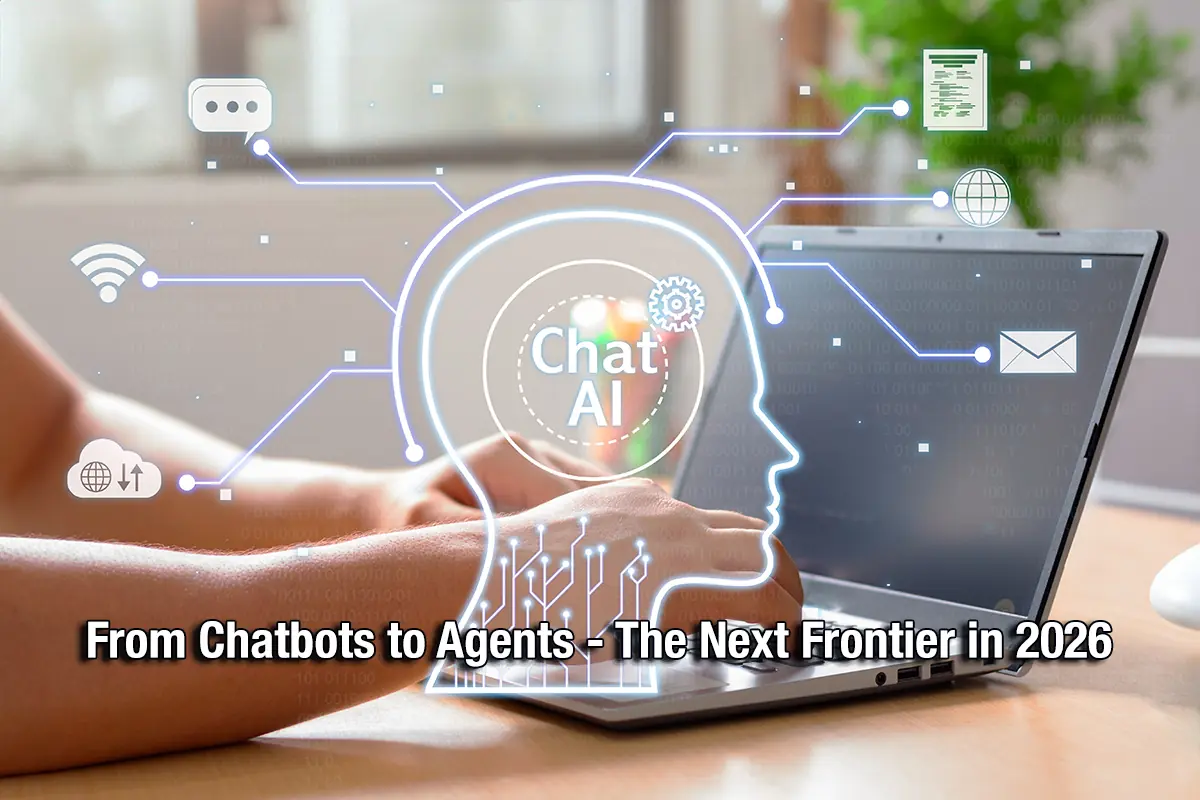
The AI landscape in 2026 has witnessed a fundamental shift: from passive tools that respond to prompts to autonomous agents that can plan, execute, and iterate on complex tasks. This article explores the emergence of AI agents, their capabilities, real-world applications, and the profound implications for how we work and interact with technology.
Introduction
For years, AI systems were essentially sophisticated autocomplete—predicting the next word, generating the next token, responding to each prompt as if it were the first. In 2026, that paradigm has been shattered. The new generation of AI systems can maintain context across hours or days, break complex goals into actionable steps, use external tools, and iterate on their own work until it's right.
This is the era of AI agents—systems that don't just respond, but act.
What Makes an AI an "Agent"?
Defining Characteristics
Not every AI system qualifies as an agent. True AI agents share characteristics:
| Capability | Description | Example |
|---|---|---|
| Planning | Decompose goals into steps | Create multi-step project plans |
| Tool Use | Interact with external systems | Execute code, query databases |
| Memory | Maintain context over time | Remember preferences across sessions |
| Iteration | Improve outputs through feedback | Refine work until correct |
| Autonomy | Operate without constant guidance | Work independently to achieve goals |
The Evolution: Chatbot to Agent
| Era | Capability | Limitation |
|---|---|---|
| 2020-2022 | Q&A systems | Single turn, no memory |
| 2022-2024 | Conversational AI | Context limited, no tools |
| 2024-2025 | Tool-augmented AI | Requires explicit tool selection |
| 2026 | True agents | Autonomous planning and execution |
Architecture of Modern AI Agents
The Agent Loop
Modern AI agents operate through a continuous loop:
┌──────────────┐     ┌──────────────┐     ┌──────────────┐
│    Perceive   │────▶│    Plan      │────▶│    Act       │
│  (Context +   │     │  (Decompose  │     │  (Execute   │
│   Tools)       │     │   Goals)     │     │   Tasks)     │
└──────────────┘     └──────────────┘     └──────────────┘
        │                                       │
        │          ┌──────────────┐             │
        └─────────▶│   Evaluate   │◀────────────┘
                   │  (Check      │
                   │   Progress)  │
                   └──────────────┘
Key Components
- Model: The underlying LLM providing reasoning
- Planning Module: Breaks down complex goals
- Tool Layer: Access to external systems
- Memory System: Tracks state and context
- Evaluation Engine: Assesses progress
Tool Integration
Agents can use many tools:
| Tool Type | Capabilities | Example Use |
|---|---|---|
| Code execution | Run Python, JavaScript | Data analysis, automation |
| Web search | Access current information | Research, fact-checking |
| API calls | Interact with services | Schedule meetings, send emails |
| File operations | Read, write, modify files | Document creation |
| Database queries | Query structured data | Business intelligence |
Leading Agent Platforms in 2026
1. Anthropic Computer Use
Claude can now:
- Navigate the web autonomously
- Interact with desktop applications
- Execute commands in terminals
- Complete complex multi-step tasks
2. OpenAI Operator
OpenAI's agent can:
- Browse the web on your behalf
- Complete form filling
- Make purchases
- Schedule appointments
3. Google Gemini Agents
Google's approach includes:
- Project-level context
- Deep workspace integration
- Code development agents
- Research assistants
4. Microsoft Copilot Agents
Enterprise-focused agents:
- SharePoint agent for document queries
- Teams meeting summarization
- Dynamics CRM automation
- Power Platform integration
5. Open Source Alternatives
The open-source ecosystem is thriving:
- LangChain Agents: Flexible agent frameworks
- AutoGen: Microsoft's multi-agent system
- CrewAI: Multi-agent collaboration
- AgentVerse: Research agent platform
Real-World Applications
Software Development
AI agents are transforming how software is built:
| Task | Agent Capability | Time Saved |
|---|---|---|
| Code generation | Write full implementations | 50%+ |
| Bug detection | Find issues before deployment | 40%+ |
| Documentation | Auto-generate docs | 70%+ |
| Code review | Analyze PRs for issues | 60%+ |
| Testing | Write and run test suites | 50%+ |
Research and Analysis
Agents excel at complex information tasks:
- Literature review: Read hundreds of papers, synthesize findings
- Data analysis: Clean, analyze, and visualize datasets
- Report writing: Generate comprehensive reports
- Competitive analysis: Gather and organize market intelligence
Business Operations
Enterprise workflows are being automated:
- Customer service: Agents handle complex support tickets
- HR processes: Handle onboarding, benefits queries
- Finance: Automate reconciliation and reporting
- Marketing: Create and optimize campaigns
Personal Productivity
Individual agents are becoming personal assistants:
- Email management: Draft responses, prioritize
- Calendar management: Schedule meetings, find times
- Research: Gather information on any topic
- Content creation: Draft documents, presentations
The Economics of AI Agents
Cost Structure
Agent economics are evolving:
| Approach | Cost Model | Best For |
|---|---|---|
| Per-task | Pay per completion | Occasional use |
| Subscription | Monthly fee for access | Regular use |
| Enterprise | Custom pricing | Large-scale |
| Usage-based | Compute + margin | Variable load |
ROI Analysis
Organizations are seeing significant returns:
| Metric | Improvement |
|---|---|
| Productivity | 30-50% increase |
| Error rates | 40-60% reduction |
| Processing time | 60-80% faster |
| Customer satisfaction | 20-30% improvement |
Challenges and Limitations
Reliability
Agent systems face significant challenges:
- Failure modes: Agents can fail in unexpected ways
- Error propagation: Mistakes compound over long tasks
- Verification: Hard to verify agent outputs are correct
- Recovery: Agents may not recognize when to ask for help
Safety Concerns
Autonomous agents raise safety questions:
| Risk | Mitigation |
|---|---|
| Unauthorized actions | Approval workflows |
| Tool misuse | Permission controls |
| Data exposure | Access limitations |
| Infinite loops | Resource boundaries |
Human Oversight
Balancing autonomy and control:
- Human-in-the-loop: Approve before critical actions
- Escalation paths: Route to humans when uncertain
- Audit trails: Log all agent decisions
- Rollback capabilities: Undo agent actions
The Future of Agents
Near-Term Developments (2026-2027)
- Multi-agent systems: Teams of specialized agents
- Persistent memory: Agents that remember across sessions
- Better planning: Improved reasoning about complex tasks
- Improved tools: More reliable and capable tool use
Long-Term Vision (2028+)
Looking further ahead:
- Personal AI companions: Agents that know you well
- Organizational agents: AI "employees" with defined roles
- Agent marketplaces: Specialized agents for any task
- Agent collaboration: Agents working together seamlessly
The Agentic World
Imagine 2030:
- Your AI handles most routine tasks
- AI "employees" augment your workforce
- Agents coordinate with each other
- You focus on creative and strategic work
Implementing Agents in Your Organization
Getting Started
- Identify opportunities: Where can agents add value?
- Start small: Pilot with limited scope
- Build trust: Prove reliability before expanding
- Iterate: Improve based on feedback
- Scale: Expand to more use cases
Best Practices
| Practice | Implementation |
|---|---|
| Clear objectives | Define what success looks like |
| Appropriate oversight | Match autonomy to risk |
| Monitoring | Track agent performance |
| Continuous improvement | Learn from failures |
Common Mistakes
Avoid these pitfalls:
- Too much autonomy: Start with human oversight
- Poor tool design: Agents need reliable tools
- Insufficient testing: Agents can fail in production
- No feedback loop: Agents need to learn
Conclusion
AI agents in 2026 represent a fundamental shift in what artificial intelligence can do. From passive tools to active participants in work, agents are transforming industries and creating new possibilities. The technology is not yet perfect—reliability, safety, and oversight remain challenges—but the trajectory is clear.
The question for organizations is not whether to adopt agentic AI, but how quickly and how effectively. Those who master agent implementation will gain significant competitive advantages. Those who wait risk being left behind.
We are entering the age of the AI agent. The agents are here, they're learning fast, and they're ready to work.
Related Articles
The Rise of AI Agent Marketplaces: Platforms Reshaping Enterprise Automation
AI agent marketplaces are emerging as the new frontier in enterprise automation, enabling businesses to discover, deploy, and manage specialized AI agents for every business function.

AI Agent Security, Performance & Enterprise Deployment: The Deep Dive
we explored the fundamental philosophies behind OpenClaw, Manus AI, and Claude Code. Now it's time for the uncomfortable conversations — the ones every CTO and security lead needs to have before production deployment.

The Agentic Revolution—How AI Is Transforming from Chatbot to Autonomous Worker
AI agents are moving beyond simple chat interactions to autonomously executing complex tasks, marking a fundamental shift in how humans work with artificial intelligence