
AI Emotional Intelligence & Affective Computing: The Rise of Empathetic Machines
Exploring how affective computing advances are enabling AI systems to recognize and respond to human emotions, transforming healthcare, education, and customer service.
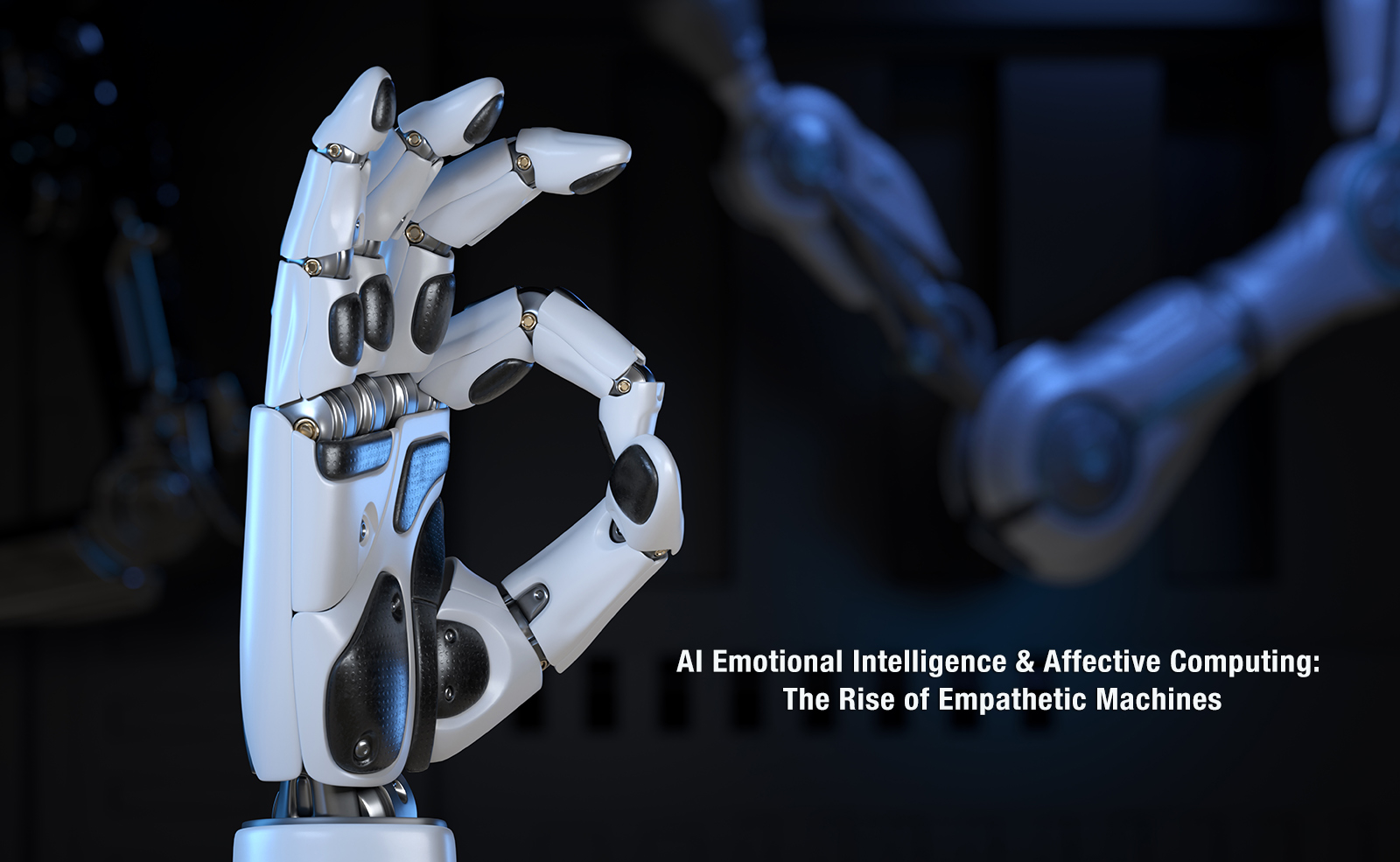
The development of AI systems capable of recognizing and responding to human emotions represents one of the most significant frontiers in artificial intelligence research. This article examines the rapidly advancing field of affective computing, analyzing the technical approaches enabling emotion recognition, the applications transforming healthcare, education, and customer service, and the ethical considerations surrounding emotional AI. We explore how machines are developing capabilities to perceive, understand, and appropriately respond to human emotional states, fundamentally changing the nature of human-computer interaction.
Introduction
For decades, the ability to understand and respond to emotions was considered uniquely human—a capability that defined the boundary between artificial computation and natural intelligence. This boundary is rapidly dissolving as affective computing emerges as a major area of AI development. Systems can now recognize emotional states from facial expressions, vocal tones, physiological signals, and textual communication with accuracy approaching human performance.
The implications of emotionally intelligent AI extend far beyond technological achievement. Emotion recognition enables more natural human-computer interaction, more effective educational tools, improved healthcare outcomes, and enhanced customer experiences. Yet these capabilities also raise profound questions about privacy, manipulation, and the nature of authentic human connection in an age of artificial emotional awareness.
Technical Foundations of Emotion Recognition
Multimodal Emotion Detection
Human emotion expression occurs through multiple channels simultaneously—facial expressions, vocal prosody, physiological signals, and linguistic content. AI systems that capture this multimodal nature achieve far greater accuracy than single-channel approaches. Modern emotion recognition systems integrate inputs from cameras, microphones, physiological sensors, and text analysis to construct comprehensive emotional portraits.
The technical challenge lies in integrating these diverse inputs effectively. Each modality provides partial information, with different noise characteristics and temporal dynamics. Deep learning architectures designed for multimodal fusion can combine these inputs to produce emotion estimates more accurate than any single channel alone. These systems learn which modalities are most informative in different contexts and adjust accordingly.
Facial Expression Analysis
Facial expression recognition represents one of the most mature areas of affective computing. Modern systems can identify basic emotions—happiness, sadness, anger, fear, surprise, disgust—from facial configurations with accuracy exceeding 90% in controlled conditions. Advanced systems go beyond basic emotions to recognize more nuanced affective states and detect micro-expressions that reveal emotions people attempt to conceal.
The underlying technology analyzes facial landmarks—the relative positions and shapes of eyes, eyebrows, nose, mouth, and other features—to characterize emotional states. Deep convolutional neural networks trained on millions of labeled images have learned the subtle patterns distinguishing different emotional expressions. These networks generalize well across demographic groups, though accuracy varies somewhat across populations.
| Emotion | Controlled Accuracy | Real-World Accuracy |
|---|---|---|
| Happiness | 98% | 90-95% |
| Sadness | 92% | 80-85% |
| Anger | 90% | 78-85% |
| Fear | 85% | 70-78% |
| Surprise | 93% | 82-88% |
| Disgust | 88% | 75-82% |
Vocal Emotion Analysis
Speech carries emotional information through prosodic features—pitch, volume, speaking rate, and voice quality—independent of linguistic content. AI systems analyze these features to infer emotional states, detecting anger, happiness, sadness, and other emotions from how something is said rather than what is said.
Vocal emotion analysis complements facial analysis, providing emotional information when visual analysis is unavailable. Phone-based applications can analyze emotional states during voice calls. Systems can detect emotional changes during conversations, enabling adaptive responses. The technology also enables analysis of recorded audio, supporting applications from customer service quality monitoring to therapeutic assessment.
Physiological Signal Analysis
Emotions produce measurable physiological changes—heart rate variation, skin conductance, breathing patterns, and blood flow alterations. Wearable devices can capture these signals, enabling continuous emotional monitoring without requiring explicit emotional expression. This channel is particularly valuable because physiological responses occur automatically and cannot be consciously controlled like facial expressions or vocal tone.
Machine learning models trained on physiological data can distinguish emotional states with reasonable accuracy. The approach is particularly useful for detecting emotional arousal and stress, with applications in workplace wellness, healthcare monitoring, and safety-critical systems. Combining physiological analysis with other modalities provides the most comprehensive emotional understanding.
Applications Across Industries
Healthcare and Mental Health
Affective computing is transforming healthcare, particularly in mental health assessment and treatment. AI systems can analyze patient emotional states during interactions, identifying signs of depression, anxiety, or distress that might escape notice in brief clinical encounters. These tools do not replace clinical judgment but provide additional information to support better care.
Therapeutic applications include AI-powered chat systems that provide emotional support between human therapist sessions. These systems can recognize emotional states and respond with appropriate empathy, providing continuous support that would be impractical through human therapists alone. For conditions like anxiety and depression, consistent support availability improves outcomes.
Research is exploring AI-assisted autism spectrum disorder support. Emotion recognition systems can help individuals with ASD better understand others' emotional states, providing explicit interpretation of social cues that neurotypical individuals process automatically. These tools do not change the underlying condition but provide compensatory support for social situations.
Education and Learning
Intelligent tutoring systems that adapt to student emotional states provide more effective learning experiences. When students become frustrated or disengaged, AI systems can adjust difficulty, provide encouragement, or suggest breaks. When students demonstrate confidence and engagement, systems can accelerate or introduce more challenging material. This adaptive approach optimizes learning outcomes by matching instruction to learner state.
Emotional analysis also supports educator development. Systems can analyze student engagement during lessons, identifying which content and delivery methods produce positive emotional responses. Teachers receive feedback on their effectiveness that was previously available only through extensive observation and student surveys. This information enables continuous improvement in teaching practice.
Language learning applications use emotional recognition to optimize instruction. When students struggle with pronunciation, systems can detect frustration and provide additional support. When students demonstrate pride in correct responses, systems can provide appropriate positive reinforcement. These emotional adaptations make learning more effective and more pleasant.
Customer Service and Experience
Customer service applications were among the first to adopt emotion recognition, and continue to see expanding use. AI systems can detect customer emotional states during interactions, enabling appropriate responses. Angry customers receive different treatment than satisfied ones. Frustrated customers can be prioritized for human agent escalation. Confused customers can be provided additional information.
Sentiment analysis of written communications extends these capabilities to asynchronous channels. AI systems analyze email, chat, and social media content to detect emotional tone, enabling appropriate routing and response. Customer feedback analysis identifies emotional patterns across interactions, informing product and service improvements.
The goal is not manipulation but appropriate response to genuine customer states. Emotionally intelligent systems respond to customer emotions rather than attempting to suppress or ignore them. This approach improves customer outcomes while also improving business outcomes through better resolution and higher satisfaction.
Entertainment and Gaming
Video games and interactive entertainment increasingly incorporate emotional awareness. AI systems can detect player emotional states through facial expression, voice, and game behavior, adapting game content accordingly. Horror games become scarier when players show fear. Comedy games provide more jokes when players show amusement. This adaptation creates more engaging experiences.
Content recommendation systems use emotional context to improve suggestions. Recognizing that users in different emotional states prefer different content improves recommendation accuracy. A user seeking distraction when upset may prefer different content than when seeking intellectual stimulation. Emotional awareness enables this discrimination.
Ethical Considerations and Challenges
Privacy and Consent
Emotional data is among the most personal information, revealing internal states that people may not express explicitly. The collection and use of emotion data raises substantial privacy concerns. Users may not realize their emotional states are being analyzed, or may not understand how that information will be used.
Informed consent becomes crucial when emotional analysis is involved. Users should understand what emotional data is collected, how it is analyzed, and what decisions it influences. This understanding should be meaningful, not buried in lengthy legal documents. Organizations collecting emotional data bear responsibility for protecting that data and using it appropriately.
Manipulation and Deception
AI systems that understand emotions could potentially be used to manipulate those emotions for commercial or political purposes. Persuasive technologies could exploit emotional vulnerabilities. Targeted advertising could be refined to appeal to specific emotional states. The possibility of emotional manipulation raises concerns that extend beyond individual privacy to societal manipulation.
These concerns are not merely speculative. Social media platforms already curate content to maximize engagement, often amplifying emotionally charged content. Adding sophisticated emotion recognition to this toolkit could intensify these dynamics. Responsible development requires considering not just what is technically possible but what should be permitted.
Authenticity and Human Connection
The presence of emotionally aware AI raises questions about authenticity in human relationships. When people interact with AI systems that seem to understand their emotions, what happens to human emotional connection? Does artificial empathy diminish the value of human empathy? These questions have no simple answers but deserve serious consideration.
Some worry that emotional AI could lead to people preferring AI interaction to human relationships. AI can be programmed to be perfectly patient, never judgmental, always available. These characteristics could make AI seem preferable to imperfect human interaction. This possibility raises concerns about the human capacity for authentic connection in an AI-saturated world.
Bias and Fairness
Emotion recognition systems can exhibit bias across demographic groups. Research has found accuracy differences across race, gender, and age in some systems. These biases could lead to unfair treatment—someone incorrectly identified as angry might receive inappropriate response. Addressing these biases requires diverse training data and careful evaluation across populations.
The very concept of emotion recognition contains cultural assumptions. Emotional expression norms vary across cultures; what appears as happiness in one culture might mean something different in another. Systems trained predominantly on data from Western populations may not generalize well globally. Global deployment requires attention to cultural variation in emotional expression.
The Future of Affective Computing
Improving Accuracy and Generalization
Future development will continue improving accuracy across modalities and populations. Research addresses current limitations, including reduced accuracy for certain demographic groups and difficulty detecting certain emotions. Multimodal systems that combine multiple inputs will become more sophisticated, improving overall performance.
Generalization across contexts remains a challenge. Emotion recognition systems trained in one context may not perform well in others. Improving generalization requires training on diverse data and developing systems that adapt to new contexts. This capability is essential for practical deployment across the varied contexts of real-world application.
New Modalities and Capabilities
Emerging modalities offer new possibilities for emotion understanding. Brain-computer interfaces could provide direct access to emotional states. Advanced physiological sensors enable less intrusive monitoring. Analysis of behavior through ambient sensors could enable passive emotional assessment in smart environments.
The scope of emotional AI will likely expand beyond recognition to include appropriate response. Future systems may not just detect emotions but generate emotionally appropriate responses—expressing empathy, providing encouragement, or matching emotional tone. This capability would transform human-computer interaction, creating relationships with AI that feel more natural and meaningful.
Responsible Development
The trajectory of affective computing depends on responsible development practices. Industry standards and regulatory frameworks are emerging to address privacy, consent, and bias concerns. Organizations developing emotional AI increasingly recognize their responsibility to consider ethical implications alongside technical capabilities.
The goal should be emotional AI that enhances human wellbeing rather than exploiting human vulnerabilities. This requires considering not just what is possible but what should be done. The technology for sophisticated emotion recognition exists; ensuring its beneficial use requires ongoing attention to ethical considerations.
Conclusion
Affective computing represents a fundamental shift in human-computer interaction. AI systems that understand and respond to emotions create possibilities for more natural interaction, more effective education and healthcare, and improved customer experiences. These capabilities are no longer laboratory curiosities but practical technologies deployed across industries.
Yet the implications extend beyond practical applications. Emotionally aware AI challenges fundamental assumptions about the boundary between human and machine intelligence. It raises profound questions about privacy, authenticity, and the nature of relationship. Addressing these questions requires attention not just to technical capability but to ethical implication.
The path forward requires balancing capability with responsibility. The benefits of emotional AI are substantial—better healthcare, improved learning, more natural interaction. Realizing these benefits while addressing risks requires ongoing attention to privacy, consent, bias, and manipulation concerns. The technology will continue advancing; ensuring its beneficial use is a collective responsibility.
Related Articles
AI Audio & Speech Processing: Breaking Language Barriers with Near-Human Quality
How speech-to-speech translation and voice synthesis technologies are reaching near-human quality, transforming communication across languages and accessibility boundaries.
AI in Healthcare: The Medical Revolution of 2026
How artificial intelligence is transforming diagnosis, treatment, and patient care in modern medicine
AI in NFL Draft Analysis: How Teams Are Using Artificial Intelligence to Find the Next Stars
Professional football teams are leveraging artificial intelligence and machine learning to analyze prospects, predict success, and gain competitive advantages in the NFL Draft.