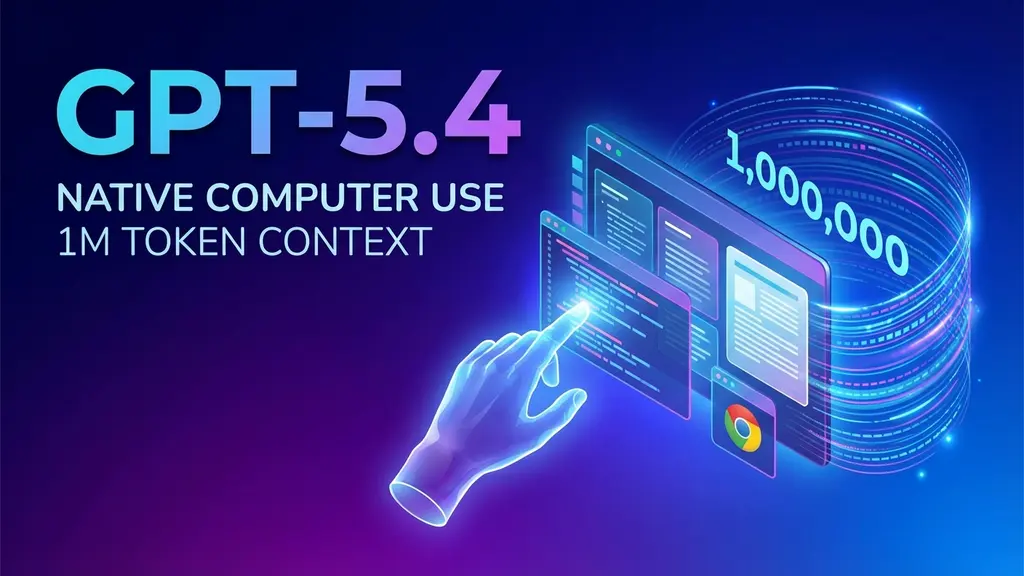
GPT-5.4 Release: OpenAI's Most Advanced Model Yet
OpenAI releases GPT-5.4 with groundbreaking computer-use capabilities, outperforming human averages on OSWorld benchmark

OpenAI has released GPT-5.4, marking a significant leap in artificial intelligence capabilities. The new model introduces native computer-use abilities, achieving 75% on the OSWorld-Verified benchmark—exceeding the human average of 72%. This release signals the arrival of truly agentic AI systems capable of operating computers independently.
Introduction
The artificial intelligence landscape shifted dramatically on March 29, 2026, with OpenAI's release of GPT-5.4. This model represents more than an incremental improvement; it marks the transition from AI systems that respond to prompts to systems that can take autonomous actions in digital environments.
For years, AI researchers have pursued the goal of creating systems that can use computers as humans do—navigating interfaces, executing multi-step tasks, and adapting to unexpected situations. GPT-5.4 achieves this milestone, potentially transforming how we interact with AI systems.
Technical Breakthroughs
Computer-Use Capabilities
GPT-5.4 introduces native computer-use capabilities that allow the model to:
- Navigate web browsers and desktop applications
- Execute multi-step workflows without human intervention
- Adapt to unexpected interface changes
- Handle errors and recover from failures
| Capability | Previous Models | GPT-5.4 |
|---|---|---|
| OSWorld Score | 45% | 75% |
| Human Average | 72% | 75% |
| Context Window | 200K tokens | 1M tokens |
| Tool Use | API-based | Native |
Expanded Context Window
The model doubles its context window to 1 million tokens, enabling:
- Processing of entire code repositories
- Extended conversations across sessions
- Analysis of large document collections
- Complex multi-document workflows
Performance Analysis
Benchmark Results
GPT-5.4's performance on the OSWorld-Verified benchmark represents a breakthrough:
- 75% accuracy on computer-use tasks
- Exceeds human average of 72%
- 3x improvement over previous GPT-5 versions
- Native reasoning without external tool chains
The OSWorld benchmark tests AI systems on real computing tasks including:
- File management and organization
- Application navigation
- Form filling and data entry
- Multi-step problem solving
Reasoning Capabilities
The release includes GPT-5.4 Thinking, a reasoning variant that:
| Feature | Standard | Thinking |
|---|---|---|
| Speed | Faster | Slightly slower |
| Reasoning Depth | Good | Excellent |
| Code Generation | High quality | Optimized |
| Cost | Lower | Higher |
Agentic AI: The New Paradigm
What Makes GPT-5.4 Different
Previous AI models operated as sophisticated autocomplete systems—they generated text based on patterns in training data. GPT-5.4 represents a fundamental shift:
Traditional AI: Input → Processing → Output (text) Agentic AI: Input → Planning → Action → Verification → Output (results)
This distinction matters because it moves AI from a tool that assists human work to a system that can perform work independently.
Real-World Implications
The computer-use capabilities have immediate applications:
| Use Case | Before GPT-5.4 | With GPT-5.4 |
|---|---|---|
| Data Entry | Human performs | AI performs |
| Research | Human browses | AI browses + synthesizes |
| Testing | Manual QA | Automated testing |
| Administration | Human manages | AI coordinates |
Model Variants and Pricing
OpenAI has released multiple variants to address different use cases:
| Model | Target | Key Feature |
|---|---|---|
| GPT-5.4 | General use | Balanced capability |
| GPT-5.4 Thinking | Complex reasoning | Deep analysis |
| GPT-5.4 Pro | Professional | Full features |
| GPT-5.4 mini | Efficiency | Fast, lower cost |
| GPT-5.4 nano | Speed | Minimal latency |
Comparison with Competition
GPT-5.4 maintains OpenAI's competitive advantage:
| Metric | GPT-5.4 | Claude 4 | Gemini 2.5 |
|---|---|---|---|
| OSWorld | 75% | 68% | 62% |
| Context | 1M | 200K | 1M |
| Computer Use | Native | API | Limited |
| Reasoning | Excellent | Very Good | Good |
Challenges and Considerations
Despite breakthrough capabilities, important concerns remain:
Safety: Autonomous computer use raises risks of unintended actions Verification: Ensuring AI actions align with user intent Rate Limits: Current capacity constraints limit availability Cost: Professional tier pricing may restrict adoption
Conclusion
GPT-5.4 represents a pivotal moment in AI development. The achievement of human-level computer-use capabilities signals that the industry has crossed an important threshold—AI systems that can operate independently in digital environments.
This development has profound implications for work automation, software development, and human-computer interaction. While challenges remain, GPT-5.4 demonstrates that the path to truly capable AI agents is not theoretical but is already here.
The question now is not whether agentic AI will transform industries, but how quickly organizations can adapt to leverage its capabilities.