
GPT-5.4 Redefines AI Agents with Native Computer Use and 1M Token Context
OpenAI's latest model brings native computer use capabilities, 1M token context window, and tool search—directly challenging Anthropic's Claude Code dominance in the agentic AI space.
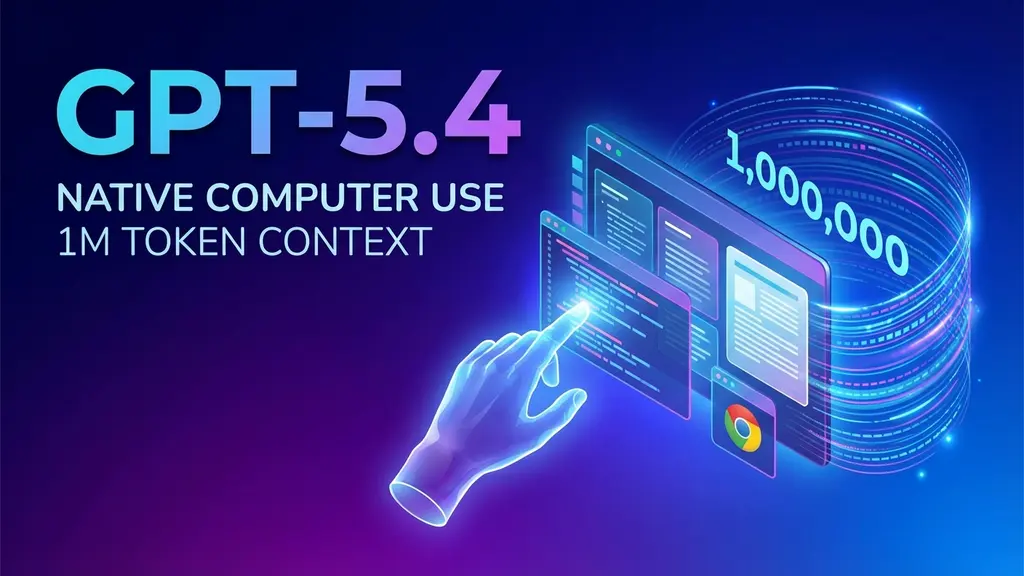
OpenAI's release of GPT-5.4 on March 5, 2026, marks a significant escalation in the AI agent race. With native computer use capabilities, a 1 million token context window in Codex mode, and a new Tool Search feature reducing token costs by 47%, OpenAI has directly positioned its flagship model against Anthropic's Claude Code. This article analyzes the technical capabilities, competitive positioning, and implications for the AI agent ecosystem.
Introduction
The AI industry has been rapidly evolving from chat interfaces toward autonomous agents—systems that can take actions on behalf of users, navigate complex workflows, and interact with computers as humans would. GPT-5.4 represents OpenAI's most aggressive move into this territory, delivering capabilities that directly challenge Anthropic's dominance in the coding and agentic AI space.
The release comes after a series of rapid model updates: GPT-5.3 Codex in February 2026, GPT-5.3 Instant addressing quality concerns, and now GPT-5.4 as the definitive agent-focused model. This acceleration demonstrates OpenAI's recognition that the agentic AI market represents the next major battlefield for AI supremacy.
Technical Capabilities Analysis
Native Computer Use
The most significant capability in GPT-5.4 is native computer use—the ability to interact with graphical user interfaces, navigate websites, execute commands in terminal environments, and manipulate files across operating systems. This represents a fundamental expansion of what AI models can do, moving beyond text generation into actionable automation.
Benchmark results show GPT-5.4 achieving 75% on OSWorld, a benchmark testing AI systems' ability to complete complex computer tasks in virtual environments. While this falls short of human-level performance, it represents substantial progress from earlier models that could only process text outputs.
The computer use capability has immediate practical applications: automated testing, data entry, documentation navigation, and complex workflow automation. Developers can now describe tasks in natural language and have the AI execute them across their development environments.
1M Token Context Window
The 1 million token context window in Codex mode expands what AI models can process in a single interaction by an order of magnitude. At approximately 750,000 words, this context capacity allows GPT-5.4 to ingest entire codebases, extensive documentation sets, or large datasets within a single conversation context.
This capability addresses a critical limitation in previous models: the need to break large projects into multiple interactions or lose context across sessions. With 1M tokens, developers can paste entire repositories, ask high-level architectural questions, and maintain coherent discussions across extensive codebases without information loss.
Tool Search Feature
The new Tool Search capability reduces token consumption in tool-heavy workflows by up to 47%. This innovation addresses a practical pain point: AI systems that must select from dozens or hundreds of available tools consume significant context tokens describing those tools for every interaction.
Tool Search enables the model to intelligently retrieve relevant tool descriptions from a larger repository rather than maintaining all descriptions in active context. This optimization makes multi-tool agent implementations more economically viable and technically efficient.
Competitive Landscape
Against Claude Code
The direct competitive target is Anthropic's Claude Code, which established itself as the leading AI coding assistant with its computer use and agentic capabilities. GPT-5.4's feature set reads as a direct response: native computer use matches Claude Code's signature capability, while the premium positioning and pricing align with Anthropic's strategy.
Benchmark comparisons show nuanced results. Claude Opus 4.6 maintains advantages in coding tasks with 80.8% on SWE-bench Verified and 91.3% on GPQA Diamond for PhD-level reasoning. However, GPT-5.4 leads in computer use (75% on OSWorld), image generation, and the new tool integration features.
The competitive dynamic suggests a period of rapid capability iteration, where each release from both companies responds to the other's innovations. Users benefit from this competition through improved capabilities, but the choice between models increasingly depends on specific use cases rather than clear overall superiority.
Against Google Gemini
Google's Gemini 2.5 Pro remains a strong competitor in multimodal understanding and reasoning. However, OpenAI's agent capabilities and developer ecosystem give it advantages in the specific market segment of coding and automation agents. Google's challenge is translating its model capabilities into developer-friendly tools that compete with the OpenAI ecosystem.
Market Implications
Developer Adoption
The agent capabilities significantly expand the addressable market for AI models. Previously, AI assisted with suggestions and text generation; now, AI can execute complete workflows. This shifts the developer value proposition from "AI helps me write code" to "AI automates my development processes."
Early adoption patterns show strongest interest from development teams working on testing automation, code migration projects, and documentation maintenance—tasks that are repetitive but require contextual understanding of codebases.
Enterprise Deployment
Enterprise adoption of agentic AI raises new considerations around security, audit trails, and governance. When AI systems execute actions on behalf of users, organizations need clear policies about what AI can and cannot do, logging capabilities for compliance, and mechanisms for human oversight.
OpenAI's enterprise positioning includes these considerations, with features designed for controlled deployment in organizational environments. However, the rapidly expanding capability set creates ongoing challenges for enterprise security teams trying to maintain appropriate controls.
Pricing and Economics
The premium pricing for GPT-5.4 reflects both the model's capability and the compute requirements for agentic tasks. Computer use, in particular, requires extended interaction times and more complex processing than simple text generation. The Tool Search optimization provides some cost reduction, but agent workflows generally remain more expensive than chat interactions.
This pricing structure creates a tiered market: casual users may stick with GPT-5.3 Instant or free tiers, while professional developers and enterprises willing to pay for automation capabilities adopt GPT-5.4. The 47% token reduction from Tool Search helps justify the premium for high-volume agent implementations.
Future Trajectory
GPT-6 Expectations
Industry analysts anticipate GPT-6 in mid-2026 with "memory" as the killer feature—persistent context that allows AI to maintain relationships and accumulate knowledge across sessions. This would further differentiate OpenAI's agent capabilities by enabling more personalized and context-aware assistance.
The progression from GPT-5.4 to GPT-6 suggests a roadmap where each release adds fundamental new capabilities rather than incremental improvements. This pace of innovation reflects the competitive intensity in the AI market.
Agent Ecosystem Growth
The GPT-5.4 release accelerates broader agent ecosystem development. Third-party developers building on OpenAI's agent infrastructure now have a more capable foundation for their applications. The combination of native computer use, extended context, and tool integration creates a platform for diverse agent implementations.
OpenAI's strategy appears to be creating a comprehensive agent platform that handles everything from simple assistance to complex automation, competing not just on model capabilities but on the surrounding ecosystem of tools, integrations, and developer support.
Conclusion
GPT-5.4 represents a pivotal release in the AI agent race, bringing capabilities that were theoretical speculation a year ago into production reality. Native computer use, 1M token context, and optimized tool integration create a compelling offering for developers seeking automation capabilities.
The competitive dynamic with Anthropic ensures continued rapid innovation. For developers and enterprises, the choice between platforms increasingly becomes about specific use case fit and ecosystem preferences rather than absolute capability differences. As agentic AI matures, the differentiation shifts from model performance to the surrounding infrastructure, integration depth, and developer experience.
The question for the market is not whether AI agents will become standard development tools, but how quickly organizations will transition from AI-assisted workflows to AI-executed workflows—and which platform will dominate that transition.
