
AI Manufacturing 2026: Smart Factories and the Industrial AI Revolution
Artificial intelligence is transforming manufacturing in 2026, with smart factory adoption hitting 47% globally and AI delivering 31% efficiency gains across the industrial sector.
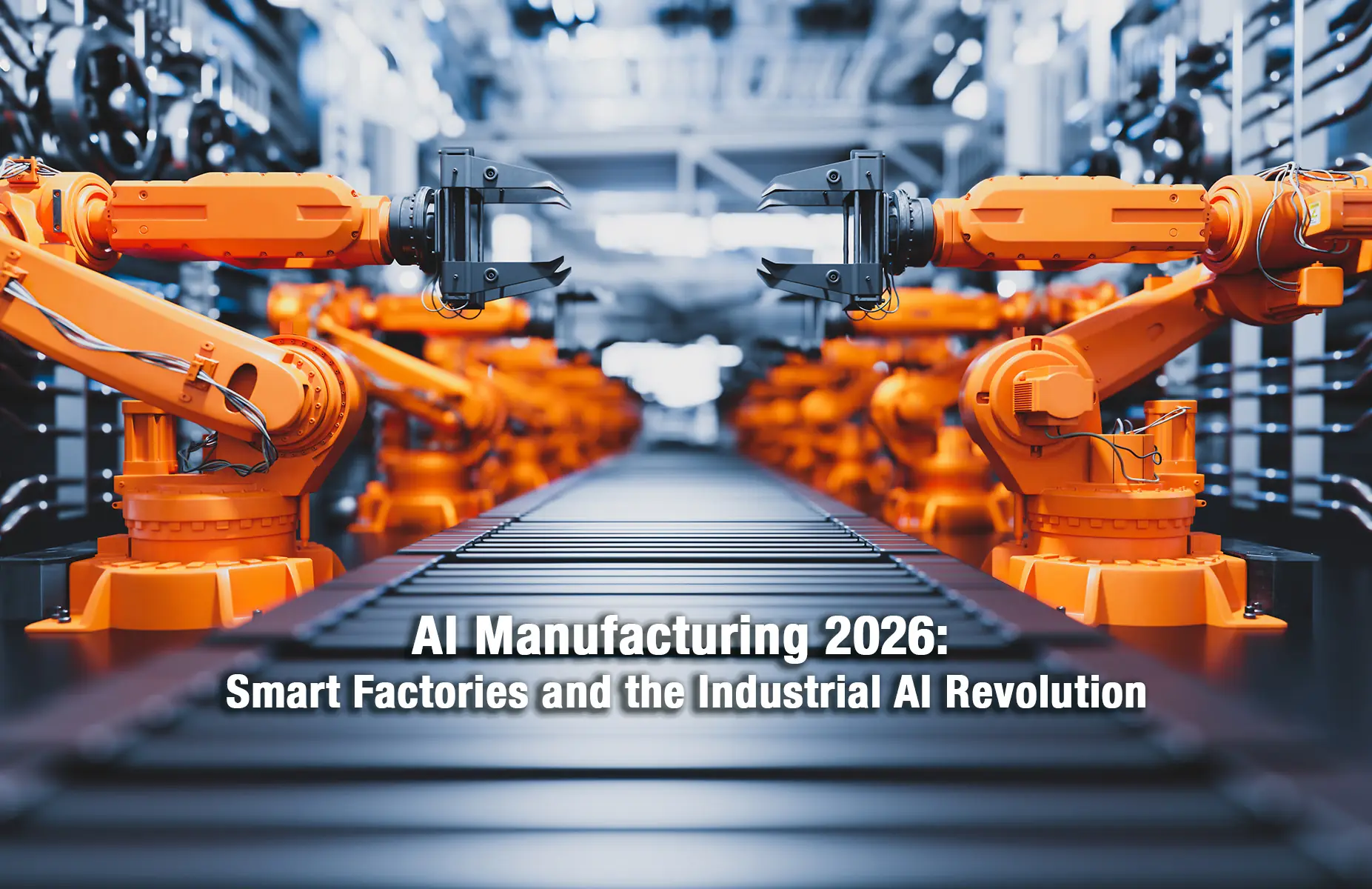
The manufacturing sector stands at the forefront of artificial intelligence adoption in 2026. With smart factory deployment reaching 47% globally and efficiency gains exceeding 30%, AI is fundamentally transforming how factories operate, how products are made, and how industrial challenges are solved. This analysis examines the current state of AI in manufacturing, exploring the technologies driving this transformation and the implications for the future of industry.
Introduction
Manufacturing has always been an early adopter of automation, and in 2026, the sector is experiencing its most significant technological transformation since the original industrial revolution. The convergence of advanced AI, robotics, IoT sensors, and edge computing is creating factories that are not merely automated but intelligent—capable of self-optimization, predictive maintenance, and continuous improvement.
The numbers tell the story: global smart manufacturing adoption has reached 47%, AI-driven efficiency gains average 31%, and the collaborative robot (cobot) market has expanded to $11.3 billion. These aren't just statistics—they represent a fundamental shift in how manufacturing works.
The Smart Factory Revolution
What is a Smart Factory?
A smart factory represents a new paradigm in manufacturing:
| Characteristic | Traditional Factory | Smart Factory |
|---|---|---|
| Decision Making | Human-driven | AI-augmented |
| Maintenance | Reactive | Predictive |
| Production | Scheduled | Adaptive |
| Quality | Sampling | Continuous |
| Integration | Siloed | Connected |
The smart factory of 2026 combines IoT sensors, AI analytics, edge computing, and robotics into a unified system that monitors every machine, predicts failures before they occur, and continuously optimizes production.
Key Technologies
Several technologies enable smart factory capabilities:
Industrial AI
- Machine learning for process optimization
- Computer vision for quality inspection
- Natural language processing for maintenance guidance
IoT and Connectivity
- Sensor networks throughout production facilities
- Real-time data collection and analysis
- Connected machinery and systems
Robotics and Automation
- Collaborative robots working alongside humans
- Autonomous mobile robots for logistics
- Robotic process automation for administrative tasks
Edge Computing
- Local processing for low-latency decisions
- Reduced dependency on cloud connectivity
- Enhanced data security
AI Applications in Manufacturing
Quality Control and Vision Systems
AI vision systems have become essential:
- Automated Inspection: 100% of products can be inspected at line speed
- Defect Detection: Identifying flaws invisible to human inspectors
- Root Cause Analysis: Tracing defects to process variables
According to the Association for Advancing Automation, 41% of manufacturers are prioritizing AI Vision systems in their 2026 automation strategies—making it the single largest AI investment category.
Predictive Maintenance
AI transforms maintenance from reactive to predictive:
| Metric | Traditional | AI-Powered |
|---|---|---|
| Downtime | 8-12% | 2-4% |
| Maintenance Cost | Baseline | -30% |
| Equipment Life | Baseline | +20% |
| Unplanned Failures | Common | Rare |
Process Optimization
AI continuously optimizes manufacturing processes:
- Real-time parameter adjustment
- Energy consumption minimization
- Waste reduction
- Throughput maximization
Supply Chain Integration
AI connects manufacturing to broader supply chains:
- Demand forecasting
- Inventory optimization
- Logistics coordination
- Supplier management
Collaborative Robots: The Cobot Revolution
The Rise of Cobots
The cobot market has expanded dramatically:
| Metric | Value |
|---|---|
| Market Size (2026) | $11.3B |
| Growth Rate | 15-20% annually |
| Primary Applications | Assembly, handling, inspection |
Unlike traditional industrial robots that operate in isolation, cobots work alongside human workers, combining the flexibility of human labor with the precision and endurance of machines.
Human-Robot Collaboration
The 2026 manufacturing floor features new collaboration models:
- Allocation by Strength: Robots handle repetitive tasks; humans handle complex decisions
- Real-Time Assistance: AI guides workers through unfamiliar tasks
- Safety Integration: Advanced sensors prevent workplace injuries
Industry-Specific Applications
Automotive
The automotive industry leads in AI adoption:
- Automated quality inspection
- Predictive maintenance for assembly line equipment
- AI-optimized production scheduling
- Supply chain visibility
Electronics
Electronics manufacturing benefits from:
- Precision assembly automation
- Component-level quality inspection
- Yield optimization through process control
- Test data analysis
Food and Beverage
AI applications in food manufacturing:
- Safety and compliance monitoring
- Quality consistency
- Process optimization for shelf life
- Supply chain traceability
Pharmaceuticals
Pharmaceutical manufacturing uses AI for:
- Process analytical technology (PAT)
- Batch optimization
- Compliance documentation
- Quality prediction
Implementation Considerations
Technology Integration
Successful AI implementation requires:
- Legacy system compatibility
- Data infrastructure investment
- IT/OT convergence
- Cybersecurity measures
Workforce Development
Human capital considerations:
- Reskilling existing workers
- New AI-focused roles
- Human-machine interaction training
- Change management
ROI Considerations
Demonstrating value:
- Clear use case identification
- Pilot program approach
- Measurable KPIs
- Phased implementation
Looking Forward: 2026 and Beyond
Near-Term Expectations
2026-2027:
- Continued AI vision system deployment
- Expansion of predictive maintenance
- Increased cobot adoption
- Digital twin implementation
Long-Term Vision
The factory of the future:
- Fully autonomous production lines
- Self-optimizing processes
- AI-driven innovation
- Circular manufacturing systems
Conclusion
AI is transforming manufacturing in 2026, delivering measurable improvements in efficiency, quality, and competitiveness. The smart factory is no longer a vision but a reality, with nearly half of global manufacturers having deployed intelligent systems.
For manufacturers yet to embrace AI, the message is clear: the competitive landscape is shifting, and those who fail to adopt risk being left behind. For those already on the journey, the focus is on scaling successful pilots and continuing to extract value from AI investments.
The manufacturing AI revolution is not about replacing humans with machines—it's about creating a new paradigm where human creativity and machine intelligence combine to achieve outcomes neither could accomplish alone. That future is here, and it starts with the smart factories of 2026.
Related Articles

Agentic AI Workflows: The Autonomous Enterprise Revolution in 2026
How AI agents are transforming from passive tools to autonomous decision-makers in enterprise workflows, with 40% of business processes predicted to be agent-managed by end of 2026.

Enterprise AI Strategy: A Comprehensive Guide for Business Leaders
Learn how to develop and implement an effective AI strategy for your organization, from initial assessment to scaled deployment.
Microsoft's $10 Billion Japan AI Investment: Strategic Analysis
Microsoft announces massive four-year investment in Japanese AI infrastructure, cybersecurity, and workforce development