Nano Banana vs DALL-E vs Midjourney: Choosing the Right AI Image Generator
A comprehensive comparison of Nano Banana (Gemini 2.5 Flash) with leading AI image generators including DALL-E and Midjourney. Find out which tool best suits your creative needs.
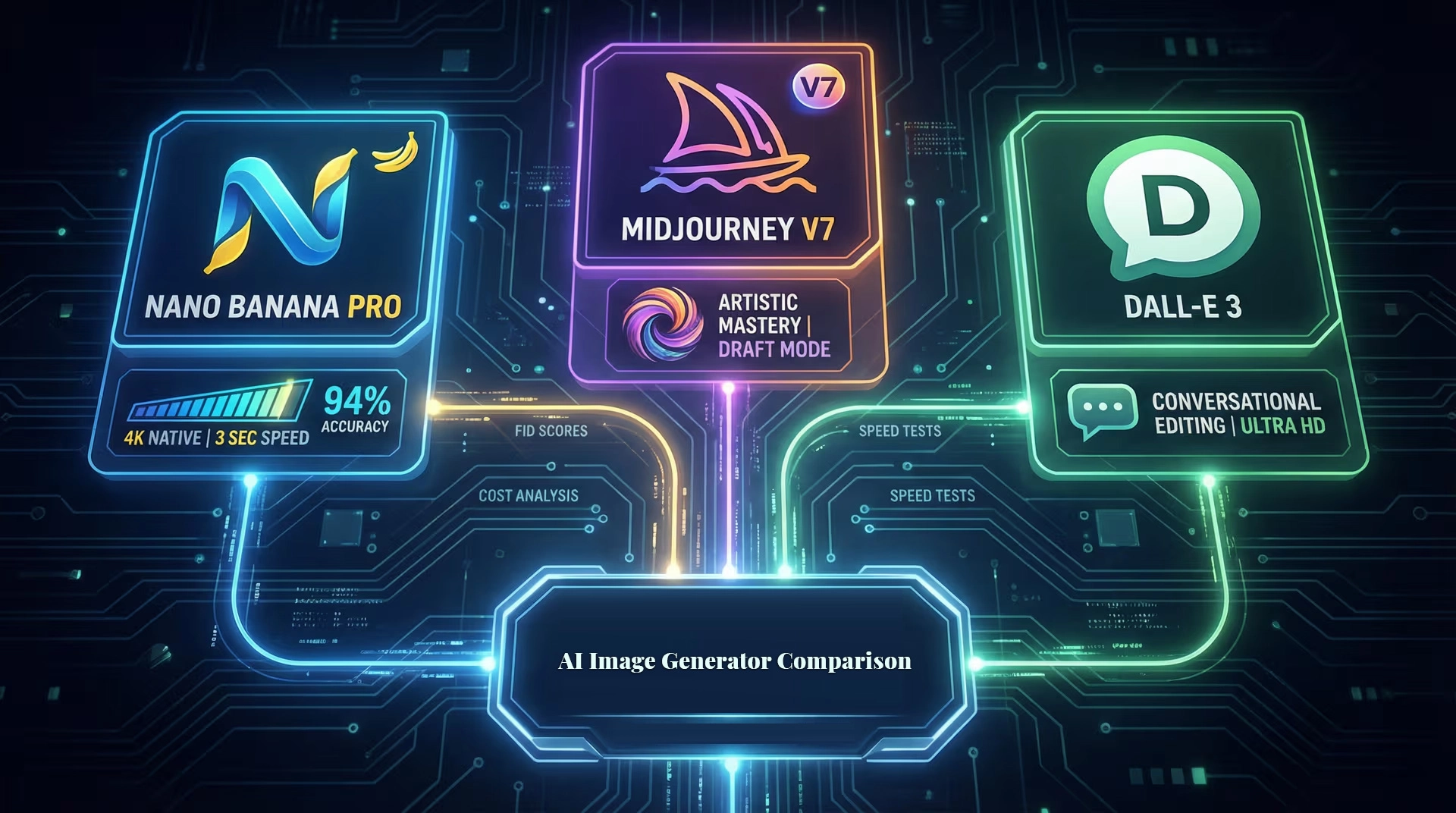
The AI image generation landscape has exploded with options, making it challenging to determine which tool best suits your creative needs. This detailed comparison examines Nano Banana (Google's Gemini 2.5 Flash Image), OpenAI's DALL-E, and Midjourney—the three leading contenders in the market. We analyze their strengths, weaknesses, pricing models, output quality, and ideal use cases to help you make an informed decision for your creative projects.
Introduction
AI image generation has transformed from a futuristic novelty into an essential creative tool used by artists, marketers, designers, and content creators worldwide. With options ranging from free tiers to premium subscriptions, understanding the differences between platforms has never been more important.
This comprehensive comparison breaks down the three leading AI image generators: Nano Banana (Google's Gemini 2.5 Flash Image), DALL-E (OpenAI), and Midjourney. By examining key factors including image quality, ease of use, pricing, and specialized capabilities, you'll gain clarity on which tool aligns with your specific needs.
Platform Overview
Nano Banana (Gemini 2.5 Flash Image)
Developed by Google, Nano Banana represents the company's entry into the competitive AI image generation space. What sets it apart is its integration with the broader Gemini ecosystem, offering unique advantages in reasoning and contextual understanding.
Key Characteristics:
- Native integration with Google AI Studio
- Part of Google's Gemini family of models
- Strong text-to-image capabilities with reasonable quality
- Free tier availability through Google services
DALL-E
OpenAI's DALL-E has been a pioneer in text-to-image AI since its initial release. Now in its third major iteration, DALL-E 3 represents significant improvements in image quality, coherence, and prompt adherence.
Key Characteristics:
- Developed by OpenAI, the creators of GPT
- Strong integration with ChatGPT ecosystem
- Robust content safety filters
- Available through API and ChatGPT subscriptions
Midjourney
Midjourney has carved out a unique position as the preferred tool for artists and designers seeking high-quality, stylistically distinctive images. Its Discord-based interface and exceptional artistic output have built a passionate community.
Key Characteristics:
- Operates exclusively through Discord
- Known for exceptional artistic quality
- Strong community and sharing culture
- Frequent model updates and improvements
Image Quality Comparison
Photorealism
When evaluating photorealistic output, each platform demonstrates distinct characteristics:
Nano Banana: Delivers solid photorealistic results, though occasionally producing images with slightly stylized appearance. Excellent for general-purpose imagery and quick concept visualization.
DALL-E 3: Improved significantly in photorealism, producing convincing images across various scenarios. Particularly strong with human faces and complex scenes.
Midjourney: Offers photorealistic modes but truly excels in artistic interpretations. When photorealism is enabled, results are impressive but may require more parameter tuning.
Artistic Styles
Nano Banana: Capable of various styles through descriptive prompts. Performs well with mixed media and contemporary styles.
DALL-E: Strong across traditional art styles but sometimes produces images that feel "AI-generated" to trained eyes. Excellent for illustrative content.
Midjourney: The clear leader in artistic quality. Exceptional at creating distinctive, gallery-worthy pieces across countless styles. Famous for its unique aesthetic that many consider superior to real artists.
Prompt Adherence
Nano Banana: Good prompt following with occasional unexpected interpretations. Benefits from specific, detailed descriptions.
DALL-E 3: Excellent prompt adherence, often exceeding expectations in following complex instructions. Particularly strong with text integration.
Midjourney: Requires more skill to direct precisely but rewards experimentation. Sometimes produces results different from but better than the original intent.
Ease of Use
Learning Curve
Nano Banana: Low barrier to entry. Familiar Google interface with straightforward text input. Ideal for beginners or those transitioning from other AI chatbots.
DALL-E: Very accessible through ChatGPT interface. Natural language processing means simple prompts yield good results.
Midjourney: Steeper learning curve due to Discord interface and parameter-based system. Requires understanding of various commands and settings. Worth the investment for serious artists.
Interface and Workflow
Nano Banana: Clean integration with Google AI Studio. No additional software required. Quick access through web browser.
DALL-E: Available through ChatGPT (both free and paid tiers) and API access. Familiar chatbot interface.
Midjourney: Unique Discord-based workflow. Users interact through the Midjourney Discord server or personal servers. Takes time to set up but becomes efficient once mastered.
Features and Capabilities
Image Editing
Nano Banana: Offers inpainting and outpainting capabilities. Integration with Google's broader AI tools provides additional editing options.
DALL-E: Includes DALL-E Editor for precise modifications. Inpainting and outpainting available. ChatGPT integration enables conversational editing.
Midjourney: Strong editing through prompt parameters and the /describe and /prefer commands. Extensive variation and upscaling options.
Text Generation in Images
Nano Banana: Mixed results with text. May require post-processing for clean text integration.
DALL-E: Significantly improved at generating text within images. Can create signs, labels, and text-heavy compositions.
Midjourney: Struggles with text generation. Often produces illegible or incorrect characters. Best to add text separately in post-production.
Batch Generation
Nano Banana: Supports multiple image generation through batch processing.
DALL-E: Available through API for automated workflows.
Midjourney: Allows grid generation for rapid iteration. Strong focus on exploring variations.
Pricing Comparison
Free Tier Availability
Nano Banana: Offers free access through Google AI Studio. Generous usage limits for casual users.
DALL-E: Limited free access through ChatGPT with occasional credits. Not intended for heavy free usage.
Midjourney: No free tier. Requires paid subscription from the start.
Paid Plans
Nano Banana: Integrated with Google services. Competitive pricing for API access. Often included with Gemini subscriptions.
DALL-E:
- ChatGPT Plus: $20/month (includes DALL-E 3 access)
- API: Pay-per-use pricing
Midjourney:
- Basic Plan: $10/month
- Standard Plan: $30/month
- Pro Plan: $120/month
- Mega Plan: $120/month (fast generation)
Use Case Recommendations
Best for Beginners
Nano Banana and DALL-E both offer accessible entry points. If you're already familiar with Google products or ChatGPT, either provides an easy starting point.
Best for Professional Artists
Midjourney remains the top choice for professional artists seeking exceptional artistic quality. The Discord workflow, while unusual, becomes powerful once mastered.
Best for Commercial Content
DALL-E offers robust commercial usage rights and strong integration with business tools. Enterprise features and API access make it suitable for commercial workflows.
Best for Quick Prototyping
Nano Banana excels when speed matters. Fast generation and free access make it ideal for rapid concept exploration.
Best for Integration
DALL-E benefits from OpenAI's ecosystem and extensive API documentation for developers integrating AI image generation into applications.
Strengths and Weaknesses Summary
Nano Banana
Strengths:
- Free access with generous limits
- Google ecosystem integration
- Fast generation speed
- Easy to use
Weaknesses:
- Less established than competitors
- Occasional inconsistent quality
- Smaller community for troubleshooting
DALL-E
Strengths:
- Excellent prompt adherence
- Strong text generation
- ChatGPT integration
- Established reliability
Weaknesses:
- Less distinctive artistic style
- Limited free access
- Can feel generic at times
Midjourney
Strengths:
- Superior artistic quality
- Strong community
- Frequent improvements
- Excellent for creative exploration
Weaknesses:
- Steep learning curve
- No free tier
- Discord-only interface
Making Your Decision
Questions to Ask Yourself
- What's your primary use case? (Personal art, commercial content, quick prototyping)
- What's your budget? (Free options vs. premium subscriptions)
- How much time can you invest in learning? (Quick start vs. mastery journey)
- What's most important? (Quality, speed, ease of use, artistic uniqueness)
The Final Verdict
There's no universally "best" AI image generator—only the best tool for your specific situation:
- Choose Nano Banana if you want free, fast, accessible image generation integrated with Google's ecosystem
- Choose DALL-E if you prioritize reliability, commercial usage rights, and ChatGPT integration
- Choose Midjourney if artistic quality is paramount and you're willing to invest time in mastering the tool
Many creators use multiple platforms for different purposes. The good news? All three continue improving rapidly, making AI image generation an increasingly powerful creative medium for everyone.
Conclusion
The AI image generation landscape offers something for every creator. Nano Banana brings accessibility and Google integration, DALL-E delivers reliability and commercial readiness, and Midjourney continues to push artistic boundaries.
Rather than viewing these as strictly competing tools, consider them complementary options in your creative toolkit. Many professional creators subscribe to multiple platforms, using each for its particular strengths.
As AI image generation technology evolves, expect continued improvements across all platforms. Stay open to experimenting with different tools, and don't be afraid to combine AI-generated assets with traditional creative work. The future of visual creativity is hybrid, collaborative, and more accessible than ever before.
Related Articles
The Anthropic-Nvidia-Microsoft Partnership: Bringing One Gigawatt of AI Compute Online
The historic $15 billion partnership between Anthropic, Nvidia, and Microsoft will bring over one gigawatt of AI compute capacity online by 2026. This article examines what this massive infrastructure investment means for the AI industry, the competitive landscape, and the future of AI capability development.
Anthropic's Revenue Surge to $2.5 Billion: How Claude Code Conquered the Developer Market
Anthropic has achieved an unprecedented $2.5 billion in annualized revenue, driven primarily by Claude Code's dominance in the AI coding assistant market. This article examines the factors behind Anthropic's rise, the competitive landscape, and what this means for the future of AI-powered software development.
Gemini 3.1 Pro with 1M Token Context: Google DeepMind's New Frontier
Google DeepMind's Gemini 3.1 Pro, released in February 2026, represents a quantum leap in large language model capabilities. With its groundbreaking 1M token context window and 77.1% score on ARC-AGI-2, it's setting new standards for multimodal AI.